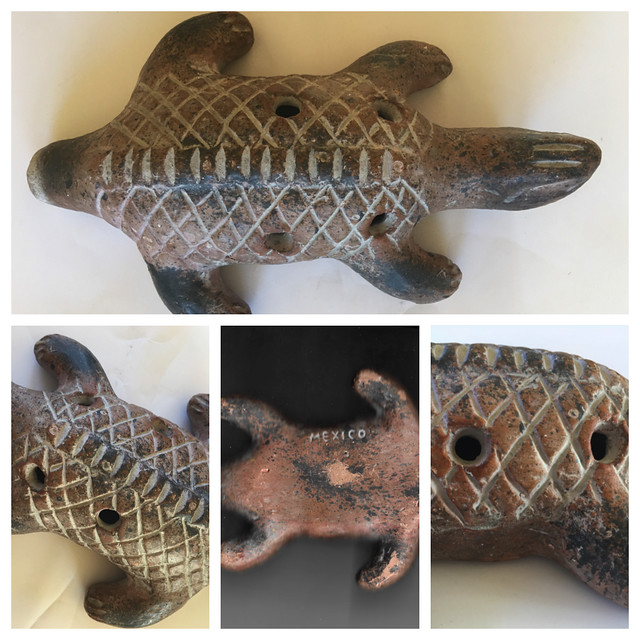
I bought this little handmade clay flute in 1982, which means this must be the single oldest instrument that I own. It cost 5 Dutch guilders at the time (roughly 2,50 euro, I suppose). It’s certainly the only item from 1982 that I have in my entire house. I made one of my first recordings with this flute, and I still use it every now and then in combination with electronic treatments.
On one occasion the flute slipped through my fingers and fell to the floor, but surprisingly it didn’t break. Another time I had this admittedly stupid plan, which was to change the color, and an even more stupid plan, which was to use fire to do so. I figured the fire would remove the original color. It didn’t work, but it didn’t hurt it, either, fortunately. The flute still has its original color, and it is still working fine. These days I am very careful with it, and I appreciate that this little instrument is still with me.
This material originated as something I made for a project that didn’t work out. At first I wasn’t sure what, if anything, to do with it, but then I realized I like it just as it is. I decided to not add anything, and to instead simply mix these six tracks (two for each part, as this piece is basically in three parts) together into one file. That file then became this EP.
Now on bandcamp: And We Fall And We Murmur And We Sing. (March 14th, 2019)
I collaborated on a second project with Martin Hoogeboom.
With Ulrich Langenbach, Aoki Satoru and Wodwo.
Previous collaboration with Martin Hoogeboom (January 14, 2016):
Michel Banabila & Willem Cramer first worked together in Chi (1984-1986), (banabila.blogspot.com/2016/08/chi-original-recordings_6.html) and later in East Meets West (1990-1991), (banabila.blogspot.com/2016/08/east-meets-west-hoy-babo-hoy.html). In 1996 they collaborated with Chris Grem making a score and performing live in a dance production by Lieber Gorilla. (banabila.blogspot.com/2016/08/lieber-gorilla-visioenen.html)
This 2018 EP is their first new collaboration in 22 years.
Viola sounds were contributed by Oene van Geel and violin sounds were contributed by Salar Asid. Willem Cramer is a composer & multi instrumentalist, living and working (like Banabila) in Rotterdam. www.willemcramer.com/audio
Willem Cramer: ebow guitar, bass, synthesizer & programming.
Michel Banabila: sampler, turntable & synthesizer.
Oene van Geel: viola (1 & 2).
Salar Asid: violin (2).
Composed, recorded, & produced by Michel Banabila & Willem Cramer. Artwork by Michel Banabila.
A special thanks to Marc Weidenbaum for suggesting the album title.
Found sound from youtube. This month I started to sample voices and environmental sounds again... Combining lots of samples, often amazed by synchronicity. I couldn't stop, as I was enjoying it a lot, and two wonderful contributions by Joost Kroon and Maryana Golovchenko completed this little EP, that sounds perhaps more like my previous VoizNoiz albums. Furthermore I used some photos from recent trips for creating the artwork, inspired by the music. These recordings are available as a download, and track 1 & 3 are also available on CD
AMBIENT BLOG
When he introduced his recent digital-only EP-release Jump Cuts, Michel Banabila hesitantly apologized for the fact that it wasn’t exactly experimental music. But because he enjoyed making it so much he decided to release it to the public. While it may not exactly be abstract hardcore experimental music indeed, I can probably safely assume that this is still much too experimental to the ears of about 95% of radiomakers and – listeners. But what is more important: it’s a return-to-style to the music that bears the unique Banabila trademark. The kind of patchwork sounds he created for previous albums like Voiznoiz and Precious Images – let’s call it his pre-abstract-electronic era. The kind of music that also perfectly fits theatre, dance, documentary or movies soundtracks. A jump cut in film editing is a cut in which two sequential shots of the same subject are taken from camera positions that vary only slightly, giving the effect of jumping forwards in time. Banabila achieves the effect by synchronizing all kinds of seemingly unrelated found sounds and vocal snippets with a compelling background rhythm track. It’s easy to hear why Michel Banabila enjoyed creating these tracks so very much. I’d say: don’t worry about experimentalism…. more of this, please! (Peter van Cooten)
NIEUWE NOTEN:
‘Jump Cuts’ is het derde recente album en in tegenstelling tot ‘Music for Viola and Electronics II’ en ‘Error Log’ is dit album alleen digitaal te verkrijgen. Naast een gastbijdrage van drummer en percussionist Joost Kroon, die ook op ‘Music for Viola and Electronics II’ meewerkt, horen we zangeres Maryana Golovchenko. Verder maakt Banabila hier veel gebruik van veldopnames en allerhande samples. Dit album is tevens opvallend ritmisch, zeker in vergelijk met de twee andere albums. (Ben Taffijn)
UTILITY FOG - FBI RADIO:
Michel Banabila's latest EP sees him returning to rhythmic sampled vocals, with a pan-world music feel. In some ways it could be a throwback to the '90s ethnomusicology of Deep Forest or something – or even Jean-Michel Jarre's strange, groundbreaking Zoolook, but it has enough of a contemporary sheen to set it apart, particularly with the glitchy vocal interruptions. Calming dubby grooves and lovely disembodied vocals make for great travelling music (even if you're sitting on your sofa travelling in your head). (Peter Hollo)
MUSIC WON'T SAVE YOU:
Reduce da una nuova collaborazione con Rutger Zuydervelt (“Error Log”), Michel Banabila racchiude in un Ep digitale una serie di divertite variazioni su field recordings e samples vocali, rimaneggiate e plasmate in quattro brani dalla poliedrica resa sonora. In “Jump Cuts” l’artista olandese torna ad applicare l’approccio istintivo e impressionista di lavori quali “Voiznoiz” e “Precious Images”, discostandosi in parte da sperimentazioni dotate piuttosto di una matrice cerebrale o concettuale. Se nei brani collocati in testa e in coda della breve tracklist il naturalismo elettro-acustico elettro-acustico della materia grezza delle registrazioni affiora in superficie appena contornata da oscillazioni avvolgenti e minute screziature, nei due pezzi centrali sono le componenti ritmiche a prendere decisamente il sopravvento, sotto forma di pulsazioni sintetiche che, lungo i nove minuti della title track, assumono cadenze incalzanti. Il tutto sembra rispondere a un’estemporaneità persino divertita, che contribuisce a desacralizzate l’essenza stessa del linguaggio sperimentale di Banabila, evidenziandone al contempo potenzialità insospettate e appunto discendenti dalla capacità dell’artista olandese di cogliere l’attimo, assemblandone gli elementi e modellandolo secondo la mutevole ispirazione del momento. (Raffaello Russo)
NOWAMUZYKA:
Michel Banabila to muzyk, kompozytor i producent. Jego kariera zaczęła się wraz z wypuszczeniem albumu „Voiz Noiz” w 2000 roku, który został bardzo dobrze oceniony przez krytyków. Wyprodukował wiele ścieżek dźwiękowych do filmów pełnometrażowych, dokumentalnych, jak i sztuk teatralnych. Holender ma na swoim koncie mnóstwo różnych kolaboracji. W ubiegłym roku wydał znakomitą EP-kę wraz z kolektywem Cloud Ensemble (recenzja). Zaś w tym roku opublikował kilka interesujących wydawnictw: Michel Banabila & Oene van Geel – „Music for viola and electronics II” (recenzja), Banabila & Machinefabriek – „Error Log” i Banabila, Erker, & Samson – „Viewpoint”. Najświeższą jego pozycją jest solowa EP-ka, pt. „Jump Cuts” (Tapu Records, czerwiec 2015). Inspiracją do stworzenia tego materiału były sample z YouTube’a pochodzące z amatorskich klipów. Na EP-ce znalazły się cztery kompozycje, dzięki którym twórca wraca do swoich korzeni, a mianowicie do tego, co prezentował m.in. na krążku „VoizNoiz”. Banabila zaprosił do współpracy dwóch artystów: Joosta Kroona – (perkusja w „Jump Cuts”) i Maryanę Golovchenko – (wokal w „Field Trip”). Z kolei sam odpowiada za gitary, syntezatory, field recording, głos, pad kaoss, meksykański flet turtle, elektronikę i instrumenty perkusyjne. Minialbum „Jump Cuts” to niezwykle ciekawa fuzja przeróżnych brzmień, od elektroniki, jazzu, krautrocka, etno aż po downtempo, ambient czy muzykę eksperymentalną. (Łukasz Komła)
WSZYSTKIE STANY SKUPIENIA:
Jeśli spędzacie popołudnie na jutiubach, to możecie równie dobrze posłuchać najświeższego materiału od Michel Banabila. Jump Cuts to cztery ciekawe utwory inspirowane amatorskimi filmikami na wyżej wspomnianym portalu. Wiele się dzieje w tej przestrzeni. Zarówno muzycznie, jak i instrumentalnie. Szkoda tylko, że tak szybko mija.
GONZO CIRCUS 129:
Op het alleen digitaal verkijgbare Jump Cuts laat Banabila zich van een toegankelijke kant zien. 'Field Trip' is met zijn ritme en betoverende stem van Maryana Golovchenko misschien wel zijn meest poppy nummer ooit opgenomen. Tussen haar stem zijn veel omgevingsgeluiden te horen en dat is ook elders op dit album het geval. Zoals in het lange ambient-achtige eerste deel van de titeltrack waarin het tempo gaandeweg word opgevoerd door ritmische percussie. In 'Take Me There' zit je dankzij gemelanklanken en omgevingsgeluiden ineens in Nederlands Indie. In 'Tortoise' waan je je door de combinatie met trompet in een nummer van Jon Hassell. Bij de bandcamp-versie van 'Jump Cuts' zit een gratis bonustrack met alleen maar rustige elektronica en field recordings. (Oscar Smit)
Released June 21, 2015.
Michel Banabila: guitar, keys, field recordings, voices, kaoss pad, samples from youtube amateur video recordings, mexican turtle flute (with ZPlane treatment), electronics, percussion, logic audio, melodyne and artwork.