Pierre Bastien and Michel Banabila return with Nuits Sans Nuit, their second collaboration following their Baba Soirée debut from 2023.
Recorded as an intuitive exchange between Rotterdam and Valencia, the album emerged from a simple ping-pong process: Banabila sculpted sounds and atmospheres, to which Bastien responded with his distinctive instrumental palette: flute-augmented cornet, mechanised log drum, and more. Mixed by Banabila, the result is a raw yet immersive work that resonates with a somnambulant, wide-awake presence.
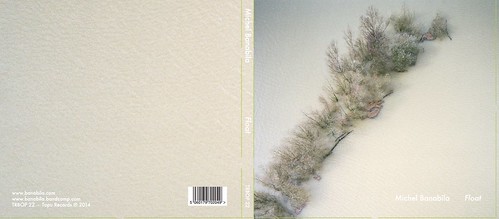
Pierre Bastien: "The dreamlike quality of our recordings reminded me of a book I read years ago: ‘Nuits Sans Nuit Et Quelques Jours Sans Jour’ by Michel Leiris. Around that same time, some fifty years ago, I was playing in Nu Creative Methods with Bernard Pruvost, a duo that appears on the Nurse With Wound list. Since then, Pruvost has turned to painting, and his work is as dreamlike as our music. We asked him to contribute one of his paintings for the album cover."
"I don't know how to describe the feeling of these crazy times we live in," says Banabila. "Les plus désespérés sont les chants les plus beaux,” Bastien quotes De Musset.
Wordless yet deeply expressive, the album invites listeners into a space of contemplation, where meaning emerges through immersion — like ritual music carrying an unspoken message. Echoes of saudade, blues, fado, and soleá surface in the duo’s playful noise, reimagined through their singular vocabulary.
PIERRE BASTIEN
Cornet augmented with rotary flutes (1), Sintir (2), Rabab and pipe (3), Roll piano (4), Mechanized steel drums (5), Prepared cornet (2, 6, 10, 11), Mechanized log drum / Sanza / Hand drum (7), Cornet and mechanized zheng (8), Mangbetu harp kundi, Talking drum tama (9).
MICHEL BANABILA
Software instruments, Sampler, Melodica (9), Wooden flute (2), Found objects (1+11), Percussion (1, 2, 4), Field recording (5+6), Mexican Turtle Flute (9), E-bow effects (8), Voice (8), Mix.
Two visionary maestros, Pierre Bastien and Michel Banabila, unite in their first collaborative album, Baba Soirée. The veterans of electronic music bring their unique expertise to the table, resulting in a captivating fusion of experimental styles. Bastien’s mechanical loops and fantastic instrumental setups merge seamlessly with Banabila's sound design and impeccable skills of sampling collages. It's not a dance party, nor is it an avant-garde intervention. It's a soirée: a cultivated evening of sonic alchemy hosted by these two charismatic gentlemen.
Pierre Bastien is a composer and multi-instrumentalist with a background in French literature. He has spent decades crafting an idiosyncratic world of experimental sound with his self-built mechanical orchestra Mecanium. It was most notably showcased in audiovisual releases on Aphex Twin's Rephlex label. Bastien's creations are a mesmerizing combination of traditional instruments (he has a vast collection) and mechanical automatons. The violin in the track Rotomotor, for example, is physically played by one of his machines. In Baba Soirée, Bastien also plays a prepared cornet (Slow Dance, Banbas Aura), infusing the recordings with a breathy, dreamy dimension.
Michel Banabila, a sound artist, composer and producer, possesses an eclectic musical repertoire that defies genres. His blend of minimal electronica, tribal ambient, and neo-classical influences has earned him a prominent place in the world of experimental music, and an impressive discography (Knekelhuis, Bureau B, Séance Centre, a.o.). Banabila serves as the creative sampling editor for Baba Soirée, expertly weaving together the recordings to craft an evocative sonic tapestry.
The two share a curiosity for traditional instruments from various cultures. The instruments used in the recordings are shown in the cover artwork. A mutual admiration for each other's work paved the way for this fruitful artistic partnership of the Rotterdam-based artists: Collaborating on a single as a fundraiser for Yemen in 2022 set the stage for the creation of Baba Soirée.
For Pierre Bastien, Dada, Fluxus and International Situationism have played a significant role in shaping his artistic vision. The title Baba Soirée is an homage to Kurt Schwitters and Theo van Doesburg's "Kleine Dada Soirée" collaboration which took place exactly a century ago. There's an unmistakable stoicism and an anarchic not-giving-a-f*** attitude in these recordings by Bastien & Banabila, which resonates in the light of this Dada reference.
Pierre Bastien & Michel Banabila ‘Baba Soirée’ Album Out 27th of October 2023.
REVIEWS / QUOTES:
THE WIRE
'The duo’s veteran status is important - they don’t give a flying one about fitting in with our preconceptions, let alone the orthodoxies of so much experimental sound, and Bastien’s fondness for the juxtaposed playfulness of Dada, Fluxus and Situationism is clear throughout (the title Baba Soirée is a homage to Kurt Schwitters and Theo van Doesburg’s Kleine Dada Soirée collaboration which took place a century ago). You can imagine this music accompanying a masked performance of sound poetry in a Zurich cafe at some point between the wars, but after a while you find yourself settling into something mesmeric and hypnotic, because Banabila merges aspects of sound design and collaged samples with Bastien’s Don Cherry-esque improvisations into a true fusion of the ambient and glitchy. Baba Soirée is exactly the right title - this doesn’t hit you round the head with weirdness or let you settle into a groove. rather, you find yourself bearing witness to this strangely unplaceable mix of the live and the layered.' (Neil Kulkarni)
HHV MAG
Zwei Altmeister an den Maschinen, da schnurren sie (die Maschinen) wie afro-polynesische Babykatzen. Tribal-Ambient-Soundguru Michel Banabila und der Mann mit dem mechanischen Orchester, Pierre Bastien, zusammen auf einer Platte, das alleine ist hat ja schon was. Und »Baba Soirée« ist alles andere als ein Gimmick-Album, ist nicht einfach nur die von einem Booker initiierte Ehrenrunde. Die beiden Rotterdam-Residents haben sich hierfür richtig zusammengesetzt, komponiert und hörbar harmoniert. Es ist auch ein fast schon logisches Zusammenspiel. Zum einen teilen beide Musiker seit jeher eine Faszination für strange sounds from beyond, für traditionelle Instrumente aus ganz unterschiedlichen Kulturkreisen. Zum anderen ergänzt sich ihre Herangehensweise perfekt: Die repetitive Urwerk-Musik Bastians und die vollverfriemelte Tröpfelung Banabilas fügen sich auf »Baba Soirée« zu einer lebendigen Struktur. An jedem Zipfel dieses Sounds bewegt sich etwas, Metallkugeln rollen in die endlose Nonsense-Maschine, Larven schlüpfen, Schrotthändler fliegen auf Libellenflügeln durch die Luft. Im Zusammenspiel aus Mechanischem und Amorphem entsteht die ganze Faszination, ständig wächst etwas aus dem Vorprogrammierten heraus, Cornet und Gimbri (o.ä) verleihen den kleinteiligen Stücken zusätzliche Weite. »Baba Soirée« ist durch und durch das Werk zweier Klangkünstler, die, glücklicherweise, niemandem mehr etwas beweisen müssen.
ANXIOUS Mag
„Starcia Tytanów” tak nazywam, dla własnych potrzeb wydawnictwa, tytuły, które koncentrują się na współpracy, pomiędzy minimum dwoma lub więcej artystami. Jednak warunek jest jeden: muszą to być nazwiska, pseudonimy po usłyszeniu których, odzywa się Wielki Dzwon Kanionu Muzycznego, przynajmniej dla mnie. Kilka miesięcy temu, na łamach Anxious magazine mogliście przeczytać recenzje z serii „Starcia Tytanów”: David Toop & Lawrence English – “The Shell That Speaks The Sea”.
Jak zawsze, w takich przypadkach otrzymujemy, albo cudowną perłę przyćmiewającą swoim blaskiem lub jej imitacje, którą odkładamy na półkę i zapominamy szybciej, niż ją odkryliśmy. W zamieszczonym info do przedstawianego wydawnictwa, pojawiają się informacje o nawiązaniu do Dada, Fluxus i Kurta Schwittersa i Theo van Doesburga i ich wspólnego dzieła “Kleine Dada Soirée” – robi się ciekawie. Z drugiej strony mamy zbudowaną i udoskonalaną od lat przez Basteina mechaniczną orkiestrę zwaną Mecanium oraz Banabila i jego miksturę trybalnego ambientu, procesowanej elektroniki i 4th world music – robi się jeszcze ciekawiej. Koniecznością jest dodanie, że obaj panowie są również doskonali w używaniu i kolekcjonowaniu instrumentów z różnych kultur i zakątków świata, czego wszystkiego powyższego możemy doświadczać na wielu płytach wydanych przez obu artystów przez ostatnie lata świetlne – ciekawość mnie pożera.
Zaskakujące, że “Baba Soirée” do tej pory jest ich pierwszym, wspólnym dokonaniem. Faktycznie, już po odpaleniu pierwszego kawałka duch Dada okrywa i jak opary gęstego opium spowalnia wszystko. Mała scena, na której dziwaczny Mini-Band odgrywa Dada protest song w swoim ślimaczym tempie, pojedyncze uderzenia kontrabasu i nisko strojonej perkusji, zapewne to silnikowo napędzany jeden z „członków” Mecanium orkiestry, w towarzystwie Basteina mini trąbki, która brzmi, pamiętam za dziecięcych lat, jak dmuchanie w grzebień owinięty złotkiem. Nostalgiczny klimat, połamany, zagubiony rytm cymbał czy gamelanów? To jakby bezperkusyjne Volcano The Bear grało w pomiędzy wojennej Europie. Wsiąkam w atmosferę, jednak nie na długo, ponieważ ta podróż dopiero się rozpoczyna i cut up’wy głos zaprasza nas w dalszą podróż z „wściekłą” solówką trąboidalnego instrumentu w tle. Dziwne samplo dźwięki i niskie basy wplatują swoje trzy grosze, tutaj Michel ukazuje nam swoje mistrzostwo w samplinu, korzystając z materiału / pierwowzoru Pierre. Warto wsłuchać się w powstające w ten sposób struktury utworów, które co rusz zmieniają swoją budowę i klimat. Na tym właśnie polega geniusz, pozwalający w granicy jednego dzieła eksplorować szerokie spektrum dźwiękowe, jednocześnie nie gubiąc przewodniego wątku. Dalej jedziemy, więcej zobaczymy / usłyszymy – pojawienie się stabilniejszej rytmiki utworów, to nie są jeszcze te magiczne trybale, udowadnia nam jak egzotyka i odczucie dalekich krajów może zmienić nasze ego. Dlaczego nie odskoczyć czy podskoczyć jeszcze wyżej? “Slow dance” zabiera nas na spacer po kraterowych dolinach księżycowych, organowo-swingujące pasaże zamieniają się w ala Hassellowe trąbkowe podmuchy z oddalającym się przytupem. Geniusz pokazuje nam jak w zaledwie 3:15 zrobić dziurę w głowie, sprawdźcie “Ban Bash Up” – dwa umysły w symbiozie.
Tykanie, cykanie, Mecanium orkiesta w całej okazałości, otwiera kluczowy utwór na płycie “Ancestors Mix”, rozpoczynamy rytuał przodków lub raczej odsłuchujemy go, przeniesionego w nasze realia przez obu guślarzy. Już nie po raz pierwszy Michel udowadnia nam majstersztyk w tworzeniu pierwotnych pasaży łączących egzotykę / alchemię dźwięku z dalekich regionów naszego globu z przeszłością – wsłuchując się, odniosłem wrażenie wyłapywania tego co SPK zrobiło na “Zamia Lehmanni: Songs of Byzantine Flowers”. Nie odpływajmy jednak za daleko, barwna, zmutowana trąbka zarówno w “Ban Bas Aura 1” jaki i drugiej części tego utworu prowadzi nas na akustyczny spacer w nieznane, z tą różnicą, że w drugiej części całość podlega cięższemu procesowaniu co powoduje fantastyczne zgięcia i odskoki dźwięku. Kiedy podróż powoli dobiega końca, żegnamy się galopującym “Roto motor” w towarzystwie skrzypka, którym de facto jest jednym z mechanicznych członków Mecanium. Hipnotyczne, czasami senne, a jednak podążające solidną, mocną drogą wyobraźni. Genialne.
GROOVE.DE
Eine gewisse Kargheit des Sounds und eine Spielweise außerhalb des (neo-)klassisch Erlaubten und Gewohnten zeichnet ebenfalls die Baba Soirée (Pingipung, 27. Oktober) der französischen und niederländischen Experimental-Veteranen Pierre Bastien & Michel Banabila aus. Bastien als Bastler mechanischer Loop-Maschinen und Trompeter, Banabila als Sample-Virtuose und digitaler Collagen-Schnitzler, sie wissen beide sehr gut, wie sich aus dem Abwegigen etwas durchaus Eingängiges konstruieren lässt, ohne allzu große Kompromisse einzugehen, was die gemeinsam entwickelte Soundästhetik angeht.
ONDAROCK
Assecondando la comune attitudine alla sperimentazione libera, i due costruiscono un caleidoscopio che a partire dai loop del Mecanium e da un coagulo di risonanze e glitch genera un itinerario elettroacustico impervio il cui comune denominatore è la ricerca di incastri efficaci quanto stranianti. I collage sonori risultanti, diretti con perizia da Banabila, lasciano prevalere di volta in volta le scie strumentali atmosferiche interpretate da Bastien (“Stray Carrier Pigeon”, Slow dance”) o la loro declinazione più ludica (“At The Party”, “Rotor Motor”). Questa dualità è perfettamente cristallizzata nelle due parti di “Banbas Aura”, dove alla melodia scanzonata della cornetta su un ipnotico andamento meccanico della prima metà si contrappone una compassata armonia sghemba interpolata da frequenze ruvide.
Nell’album troviamo condensata tutta l’arte affinata dai due autori nel corso degli anni, riversata in un microcosmo vibrante di anti musica, apparentemente caotica, votata ad edificare architetture sonore improbabili eppure profondamente suggestive. (Peppe Trotta)
SPECTRUM CULTURE
This collaboration between veteran experimental musicians consistently delivers on a sense of play, to the point where a few of these tracks should make you laugh out loud.
The LP begins with mild amusement, or maybe more, depending on what you think of the title, “Stray Carrier Pigeon.” It’s taken at the pace of a dirge, and the watery percussion conveys the passage of time with a somber tone. But the “lead” instrument, though something of a blues-inflected performance, has the buzz of a kazoo, or even the beloved British children’s television character Sweep. At any rate, the image is both humorous and tragic, on a small scale, and that buzzing lead melody reads as a sad clown in avian form. The track isn’t quite three and a half minutes, but it tells a rich story in that time, and feels even shorter than it is.
Think of these tracks as vignettes. “Senseless” ups the distortion and introduces a vaguely human onomatopoeia, and if it lives up to its title and does not suggest a narrative, the electronic bombast has hints of a crime drama theme song. It’s part of a sequence that plays like an evening of prime time television, leading into the hilarious “At the Party,” a bossa nova number with a melody played deliberately flat on prepared cornet. The tune would work just as well without the distortion, but that sonic tweak adds drunken personality. You can practically visualize the lampshade on its head.
The title Baba Soirée is a play on the artists’ names and on the Kleine Dada Soirée (Small Dada Evening) that artists Theo van Doesburg and Kurt Schwitters developed in 1922 as a touring event that brought Dada to audiences across the Netherlands. Like the Dadaists, Bastien and Banabila are happy to make art out of whatever is at hand, from more conventional electronics and traditional instruments to machines of their own invention. The cover art shows you what they played on the album, and one of their axes looks suspiciously like a coffee grinder.
Bastien is a Frenchman with a history of musical invention; his Mecanium is a 60-piece orchestral automaton that plays loops of his devising. Banabila is a Dutch composer with a penchant for using found objects and field recordings. Remarkably, given their common interests, this is the first time they’ve collaborated, and you can hear their musical chemistry on every track. You don’t know where Pierre ends and Michel begins.
But music isn’t all laffs, and on the album’s longest track, the nine-and-a-half minute “Ancestors Mix,” is a dizzying layered drone that sounds something like what Terry Riley’s “A Rainbow in Curved Air” might have been if it were constructed from birdsong and babies — and were funnier.
The motorik closer “Roto Motor” is played in part by one of Bastien’s automatons, taking a violin line that would fit right in on a Penguin Café Orchestra album. It’s a fitting up-tempo end to a delightful anarchy. While press notes characterize these recordings with “an unmistakable stoicism,” that does a disservice to the joy of discovery you can hear on every cut. One can easily imagine Bastien and Banabila touring Baba Soirée in some European country, and leaving audiences cheering at every stop. Don’t let the Dada reputation for nihilism color your perception of this mischievous duo. In fact, the two came together for a shared humanitarian cause, collaborating on a single in 2022 in order to raise funds for the crisis in Yemen. As meaningless as the music may seem, it means a lot to create something positive in this thoroughly broken world. (Pat Padua)
YELLOW GREEN RED
Been seeing a few of these dream-team experimental pairings lately – Anla Courtis and Vomir, for example – and now this one featuring French junk-drawer electronicist Pierre Bastien and Dutch new-age experimentalist Michel Banabila. Both of these guys have LPs on my shelves already, and while the playfully unhinged manner of Bastien’s work might not immediately seem compatible with Banabila’s soothing fourth-world atmospheres, the sonic consensus they’ve reached here is lush, sensual and strange. As expected, there’s really no telling who is doing what… a rickety rhythm box might be Bastien’s, and a looped didgeridoo might’ve been pulled from Banabila’s closet, but their cohesion is surprisingly consistent throughout, and never bogged down by too many ingredients at the same time. Samplers, synths, loops, horns, flutes, percussive instruments and at least one guitar (“Roto Motor (Erbil Mix)”), there’s just a cornucopia of instrumentation here, most of which is performed in exploratory or non-traditional ways. Even their unlikeliest of instrumental combinations work well here, a testament to the keen ears these guys have developed over their many decades in the game. Much of Baba Soirée can call to mind the self-guided wonder of Ghédalia Tazartès and the alternate realms of Jon Hassell, but Bastien and Banabila were peers of those guys, traversing similar sonic territories of unknown origin at roughly the same time. Nice to see that they’re still out there in the thick of it, teaming up, and at the top of their respective games, no less. (Matt Korvette)
It was back in February 2012 that Michel contacted me to say he had sent me an mp3 "with a funny melody". "I am just wondering if you can play that. Exactly with the same tuning", he said. I had a listen and thought "You must be joking", as what I was presented with appeared to have no fixed notes nor conventional tuning, and sounded almost impossible to play. (I learnt later that the synthesized tune he had sent me was a melodic tracking - via software - of the musical pitches inherent in the voice of a man talking, recorded in Ghana by his friend Mark Dingemanse from the Radboud University). I put the strange sounding melody on repeat so that I could listen to it again and again, and by playing along continuously with it I eventually found the required notes on the trombone. After a week I could play the whole thing. And that was 2012. More recently, I found myself thinking, "Whatever happened to that tune". I had done a lot of work on it, and it seemed to have disappeared with no resulting composition appearing. So, I searched through my archives, found mine and Michel's original recordings, and played around with them until I had the beginnings of something coherent. At this point I contacted Michel, and he performed his usual magic, and eight years later we have our composition! Over the years Michel and I have occasionally swapped musical ideas, and our 'B-side' is the result of another such exchange, from a recording a year earlier. (Robert Jarvis, Faversham, December, 2020)
This single is a download only.
Robert Jarvis: trombone.
Michel Banabila: synth & sampler.
Recorded in Faversham & Rotterdam via file sharing.
Written & performed by Robert Jarvis & Michel Banabila.
Cat. nr. TR121220.
2020 ℗ Tapu Records.
UPC 195497778669.
Cover art by Michel Banabila.
This is a new collaboration: coming soon online to all portals, 'The Woods' (Sonicontinuum / 2019). An 11 minute single by Alex Haas & Michel Banabila, featuring the amazing Bill Laswell.
The Woods is a single from the upcoming album Ruins by Alex Haas. Alex Haas (born 1963, NYC, USA,) label owner of Sonicontinuum, has been working with many renowned artists including U2, Brian Eno, Eric Clapton, Kronos Quartet, Pat Metheny and Bill Laswell. His first collaboration with Dutch composer Michel Banabila started in April on Collector, a track from Banabila's album Uprooted (Tapu Records / 2019). They then decided to renew their collaboration on The Woods, and Alex invited his long time collaborator, Bill Laswell to join this recording. The Woods became an atmospheric organic blend of experimental ambient, 4th world exotica and lush electronics. Synths and treated guitars by Alex Haas are mixed with Banabila's electronically processed voices, keys and field recordings, together with deep bass sounds by Laswell. Mixed and produced by Alex Haas. mastered by Marlon Wolterink. The Orchard release date: November 22, 2019.
Alex Haas: synths & treated guitars.
Michel Banabila: voices, keys & field recording.
Bill Laswell: bass and pedals.
Photo and design: Alex Haas.
Mixed and produced by Alex Haas.
Composed by Alex Haas & Michel Banabila.
Mastering by Marlon Wolterink / White Noise Studio.
Now on bandcamp: And We Fall And We Murmur And We Sing. (March 14th, 2019)
I collaborated on a second project with Martin Hoogeboom.
With Ulrich Langenbach, Aoki Satoru and Wodwo.
Previous collaboration with Martin Hoogeboom (January 14, 2016):
1.Michel Banabila & Mehmet Polat - In A Dark Time (03:07)
2.Michel Banabila & Mehmet Polat - Dream Stories (02:03)
3.Michel Banabila & Eric Vloeimans - Autumnal Equinox (01:12)
4.Michel Banabila & Eric Vloeimans - Forest Road (01:47)
5.Michel Banabila & Eric Vloeimans - Trust In You (02:06)
6.Michel Banabila & Mehmet Polat - Jabal Haraz (04:34)
7.Michel Banabila & Eric Vloeimans - Little Steps (01:56)
8.Michel Banabila & Mehmet Polat - Aerial View (01:00)
9.Michel Banabila & Eric Vloeimans - Looking Back (03:06)
10.Michel Banabila & Mehmet Polat - In Search For A Quiet Place (04:26)
11.Michel Banabila & Eric Vloeimans - Plume (02:20)
12.Michel Banabila & Eric Vloeimans - Speed Walk (03:52)
13.Michel Banabila - Eric Vloeimans - Mehmet Polat - Forest Road - Discovery Mix (04:52)
New Land credits:
Mehmet Polat: oud. Eric Vloeimans: trumpet. Michel Banabila: keys & electronics.
'Macrocosms' is the fourth collaboration album by Banabila & Machinefabriek. Again, Michel Banabila and Rutger Zuydervelt spent a few concentrated weeks swapping sound files and sculpting ideas to fully form tracks. This intuitive way of working and open-minded approach resulted in an album that harks back to the rhythmic playfulness of 'Travelog', while also maintaining the abstract tendencies of 'Error Log'.
The overall theme deals with the macro and micro - how incredibly tiny and insiginificant we become when zooming out, and how wondrous small worlds can be found within ours when zooming in. Artist Sarah Payton describes it beautifully in her spoken word section of the title track.
Field recordings made by Banabila at the nature reserve Biała Woda in Poland are an important addition to the music, reinforcing the sense of place, and invoking intricate, detailed worlds of their own. Combining elements of ambient, musique concrète, noise, and even the 'fourth world', this Rotterdam duo created a unique sonic world expanding their oeuvre with another fine album.
'Macrocosms' is released by Tapu Records, in digital formats, and as a limited edition CD in a beautiful six panel digipack.
THE WIRE: "On the title track artist Sarah Paynton intones “Inside the single world we think we see are a hundred thousand separate worlds”. Simple, bold keyboard arpeggios run through the track and her voice is finally subsumed into a cloud of tiny sound particles that spiral off into fractal like shapes, making it an appropriate analogy to the different levels of detail in the duo’s music". (Mike Barnes)
UTILITY FOG:
Dutch artists Michel Banabila & Rutger Zuydervelt aka Machinefabriek have been collaborating together since 2012, and their fourth album Macrocosm is out really soon! We got a sneak preview of a few tracks (the first one, and last two from this little feature), and I recommend grabbing the older releases and following either on Bandcamp so you can grab the new one when it appears. We hopped back to their first self-titled release, and to the amazing 2013 release Travelog in the middle. Banabila has been interested for decades in sounds (musical and otherwise) from the far reaches of the world, and has a long career making hybrid music from studio techniques, tape sampling & then digital methods along with acoustic instruments. Machinefabriek is best known for long drone works, but also works in shorter forms and is a master of digital sound design. It's great to have something new from their collaboration, which as always is more than the sum of its parts. (Peter Hollo)
'Macrocosms' is the fourth collaboration album by Banabila & Machinefabriek. Again, Michel Banabila and Rutger Zuydervelt spent a few concentrated weeks swapping sound files and sculpting ideas to fully form tracks. This intuitive way of working and open-minded approach resulted in an album that harks back to the rhythmic playfulness of 'Travelog', while also maintaining the abstract tendencies of 'Error Log'.
The overall theme deals with the macro and micro - how incredibly tiny and insiginificant we become when zooming out, and how wondrous small worlds can be found within ours when zooming in. Artist Sarah Payton describes it beautifully in her spoken word section of the title track.
Field recordings made by Banabila at the nature reserve Biała Woda in Poland are an important addition to the music, reinforcing the sense of place, and invoking intricate, detailed worlds of their own. Combining elements of ambient, musique concrète, noise, and even the 'fourth world', this Rotterdam duo created a unique sonic world expanding their oeuvre with another fine album.
'Macrocosms' is released by Tapu Records, in digital formats, and as a limited edition CD in a beautiful six panel digipack.
NORMAN RECORDS:
Regular collaborators Michel Banabila and Rutger Zuydervelt are back at it as Banabila & Machinefabriek with ‘Macrocosms’, the pairs fourth collaboration, no less. Beautifully presented in a matte digipak with photography by Michel and graphic design by Rutger.
It’s worth noting that the CD edition varies from the digital release, in that the individual tracks have been melted into a continuous mix for a journey interrupted by brief pauses of silence.
Across the disc, the lines between the real/organic and synthetic are blurred, utilising a seemingly endless vibrant palette of recognisable elements i.e “real” instruments and processed, electronic sounds and field recordings. The overall experience is something like glimpsing into worlds within worlds, within the world - Microcosms and Macrocosms. Something that’s always held an endless fascination for me. Take a dog for example, within that creature is a whole universe of smaller ecosystems, and other minute livings things like bacteria. Is our own planet just a single cell in a larger organism in an infinite universe? My head explodes just pondering these things. It seems the artists have similar thoughts and through sound conjure visions of these large and small scale worlds. It makes for pleasurable and thought provoking listening, at times recalling Jon Hassell and Brian Eno’s ‘Fourth World’ ambient. There’s an immense of amount of intricately detailed sound throughout the disc - like zooming into insect realms, then further into the very fabric of matter; cells, molecules and atoms. While larger sounds evoke images of weather systems and the cosmos. A wonderfully vibrant, organic sonic world that exists as a fusion of reality and imagination. (Anthony)
AMBIENTBLOG:
Their fourth collaborative album shows Michel Banabila and Machinefabriek in a playful mood, somewhat less abstract than on their previous album Error Log. Macrocosms radiates the joy of swapping sound files and surprising each other in turn with an unexpected twist of the material: field recordings from the Biala Woda nature reserve in Poland, musique concrête, noise, ambient, ‘fourth world’ samples, ‘Holger Czukay style’ sped up guitars, and whatnot… “The overall theme deals with the macro and micro – how incredibly tiny and insiginificant we become when zooming out, and how wondrous small worlds can be found within ours when zooming in.” Michel and Rutger are a perfect pair: two giants of Dutch experimental music, combining the best of many worlds. Abstract experimentalism, cinematic romanticism, impressionistic environmentalism… it’s all in the details that merge into a recognisable trademark style and manages to surprise with every new release. (Peter van Cooten)
A CLOSER LISTEN:
To date we have heard four full-length collaborations between Michel Banabila and Machinefabriek, each one different in tone. This one, while intricate and multi-faceted, is their most accessible to date. It all starts with a concept: the micro and the macro. Listening to the album is the aural version of zooming in and out with a hi-tech camera. Pieces of sound appear, migrate to different speakers, and dissipate. Zoom in and one can hear them better; zoom out and one can appreciate the overall picture. The cover art implies a scientist’s eye, so it’s no surprise that the music includes field recordings, made by Banabila in Poland’s Biała Woda (a reminder to check out Izabela Dłużyk’s Soundscapes of Summer, also recorded in Polish woods). The brightness of the album’s visual tones reflect that of the music, which at times can be downright danceable (“Stokjes”) ~ and when’s the last time one danced to field recordings? It doesn’t happen often. This joyful combination is what makes the album so accessible. One can imagine the artists opening each other’s sound files, getting excited about their next ideas, and committing them to tape. Crickets, choirs and children each find their places in “Upwards”, serving as both rhythm and adornment. The world itself is rhythmic, often intentionally but sometimes not; Banabila and Machinefabriek find hidden swayings and surround them with aural sculptures. Even when the track turns ambient, the listener recalls the tempo that launched the piece. But the title track is where everything comes into play. On this piece, Sarah Payton surprises with a spoken word segment that seems at first like a documentary excerpt, perfect for the nature (pun intended) of the release. Arriving at the album’s midpoint, the voice is unexpected, yet comforting. Inside the single world we think we see, a hundred thousand separate worlds go about their daily business, connected only by the thinnest of threads, a contingency of each only vaguely perceived by the others. Following the narrative, one zooms out even further, above the earth, recalling the photographic work of Yann Arthus-Bertrand. Piano, strings, static and samples provide an elegant backdrop against which Payton herself first approaches, then recedes, a metaphor for her own words. Some collaborations seem like work, but this one seems like play. It’s clear that the artists enjoy what they are doing and are inspired by this partnership. While we often write that we’d love to hear more of the same sounds, the duo has proven that they can change sounds and continue to entice. We already trust that their fifth album will intrigue in equal measure, no matter what its style. (Richard Allen)
I was contacted by photographer Gerco de Ruijter a few years ago. When he showed me his work I was immediately impressed. He often uses a kite with a camera attached to make photos (kite photography). All beautiful art. This is a nice documentary about how he works:
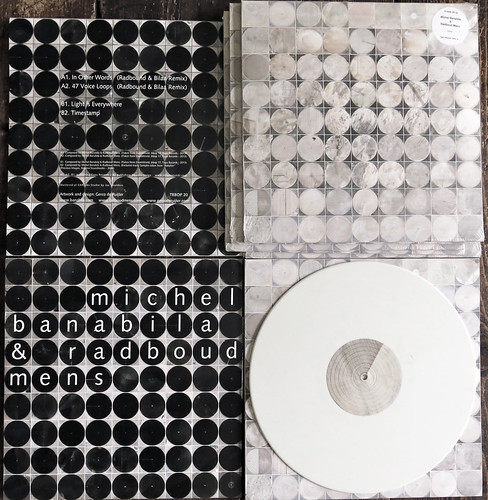
We became good friends. To my surprise it turned out he has known my music for quite a while.. and he proposed to make an album cover. That was the start of a long collaboration that is still going on. These are some of the covers he made for my albums:
12 inch vinyl EP Banabila & Mens
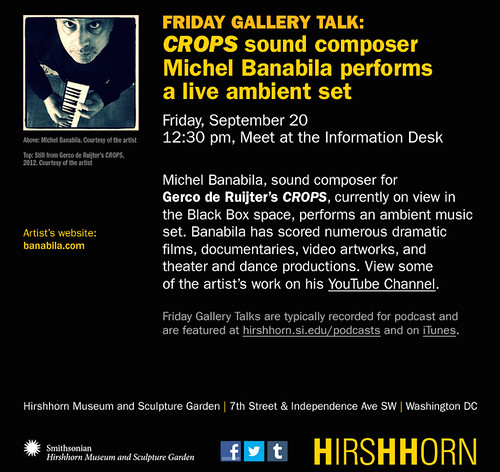
Four years ago he asked me to do the sound design for his short film 'Crops'.
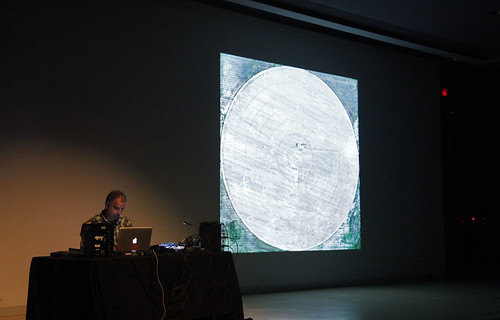
The response was really amazing ... the film was shown at many film festivals all over the world and we had an installation for 3 months in the Hirshhorn Museum in Washington where I also did a solo performance (electronics / ambient) and a small Q&A:
This morning I had a small recording session at my home with Maryana Golovchenko.
She sang a beautiful traditional entitled "Oj, Na Gori Suhyj Dub" (A dry oak on the mountain).
I added some synth and just finished the mix. It sounds dreamy .. a bit like a little meditation.
You can listen here
It's funny when I told her I just returned from Biała Woda, we realized I was not really that far from where this tune actually comes from, which is a place in the area of the Eastern Carpathian Mountains..
Note: this song was extended with a beautiful cello melody by Maarten Vos in November during the preparations for HOME, a dance performance by Conny Janssen Danst. "Oj, Na Gori Suhyj Dub" is now available on CD at the performances of HOME.
Maryana and I recorded together before, our first recording was for Jump Cuts, a track called Field Trip:
MUSIC FOR VIOLA AND ELECTRONICS.
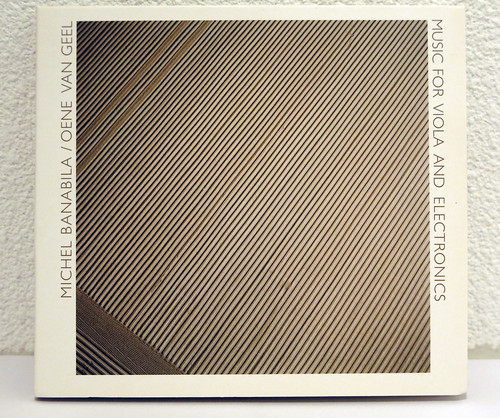
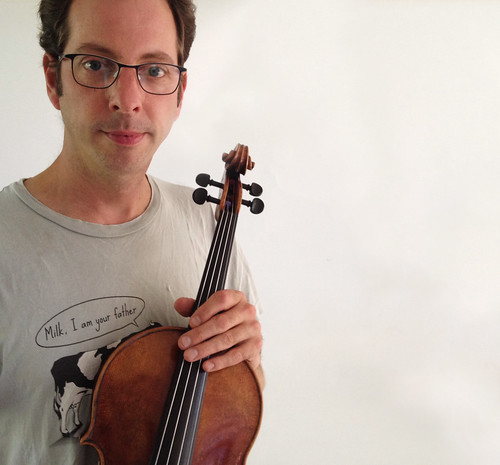
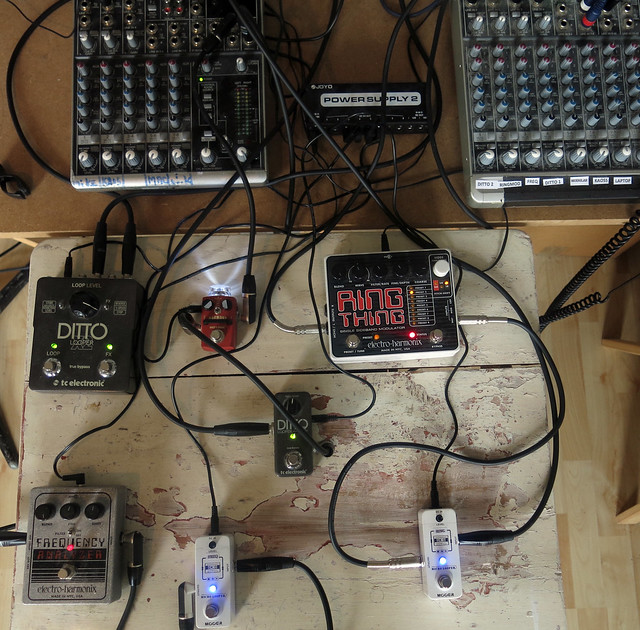
Michel Banabila and Oene van Geel first met during their collaboration for the Cloud Ensemble EP (vinyl, 2013). Excited by the idea of further combining their sound-worlds, they embarked on a new venture to continue their electro-acoustic narrative. Much of the creative process of this album emerged during the recording process itself. On the track ‘Echoes from Hadhramaut’, their mutual friend Bruno Ferro Xavier da Silva joins them, with a multilayered bass texture. Sometimes compositions of Michel are the core of the music and in other occasions Michel created a lot out of improvised viola sounds and melodies of Oene. When Oene added viola melodies and textures, sometimes he was thinking with the mindset of a composer and sometimes he was floating on intuition, looking for what the story had to tell. Michel’s very first steps on his brand new Doepfer A-100 modular system blended well with Oene’s viola and Stroh violin improvisations, and after several sessions together, they transformed their sound sculptures into these 5 new tracks, now presented on CD as : “Music for Viola and Electronics”.(with much thanks to Joeri Mol & Marc Weidenbaum)
DISQUIET:
A lovely duet for complementary toolsets, one analog, the other digital. It’s to the album’s credit that it isn’t always clear where one of those ends and the other begins. One track, “Dondergod,” gets a bit intense, in a European free improvisation sort of way, but the rest is elegant as could be.. (Marc Weidenbaum)
A CLOSER LISTEN:
The title may be bland, but the music is not. Music for viola and electronics is music for barren trees and weakening temperatures, shuttered doors and deserted streets. Its elegant beauty arrives just in time to score the starkest segment of fall, when leaves have passed their peak and daylight savings time has begun. This is a lost time, identified by its proximity to holidays, but also a rich time, yielding the last birds, the first frost. Michel Banabila‘s electronics provide the stark backdrop; Oene van Geel‘s viola provides glimpses of life in transition. The center track also includes bass: a throbbing pulse at the center of the set. But one would be forgiven for thinking that bass is present on other tracks as well, especially the booming “Dondergod”, an abrasive selection that sheers slices of sound like branches from a fallen tree. It’s no surprise that the title is Dutch for “thunder.” Banabila and van Geel met while recording last year’s Cloud Ensemble; the collective also included Machinefabriek and Grzegorz Bojanek. After trading ideas, they decided to work together again. In its softer moments (especially the gorgeous “Sinus en Snaar”), one can detect echoes of Richard Skelton; in its louder moments, Ben Frost comes to mind. Yet this specific combination – viola and electronics – is relatively rare. The humility of each performer is apparent, as composition, improvisation, and shaping duties shift from song to song, man to man: a fluid trade that yields far greater dividends. As the set progresses, one can hear the season unraveling. The viola protests: may I not continue to play outside? Yet thunderclouds are forming, and there’s no guarantee they contain rain. “Echoes from Hadhramaut” is a stratocumulus cloud preparing to erupt, which it finally does with a bang at 6:39. But then, as if relenting, the duo offers church bells and tentative melodies, leading to “Nothing But Blue Skies”, the album’s sweetest piece. One remembers a hidden truth: that the sky is as blue in winter as it is in summer. Only below can we tell the difference. Perhaps this is why the final piece is titled “Kingdom of Earth”. Finally the (actual) rain begins to fall, a cold precipitation on the verge of change, but Werner is singing in the rain. (Richard Allen)
ATTN MAGAZINE:
When Music For Viola And Electronics is at its most patient and aloft, it’s like sculpture in watercolour. “Nothing But Blue Sky” is a beautiful amber cloud whose slow spinning put emphasis on each of its faces in turn, retaining the central shape even as the sides bulge and disappear from my perspective. Slopes of viola run through each surface like palm lines, as an elegant, swooping signature upon an endless white sheet. “Sinus En Snaar” depicts wires drooping out of alignment, as pleasant chords sag into dissonance and the centre of gravity rolls through the structure like an invisible bowling ball. Tilt and rotation are often the album’s primary modes of progression, and the composition hangs as a three-dimensional object fixed in the air above the heads of Banabila and Van Geel – a central tangible idea, mutually understood yet articulated differently.
Elsewhere, the duo are stranded within their own music. “Kingdom Of Earth” is a ritual in the rain, with water shivering upon pulsating drum skins and droplets squashed between handclaps, the bow fidgeting and groaning uneasily as if implanting grim prophecy into the distant cracks of thunder. “Dondergod” is like a pitch-black maze created in Nikola Tesla’s basement, full of slamming industrial doors and sudden fountains of free-flowing electricity, implanting artificial zig-zag into a collage otherwise comprised of vapour and sunlight. Perhaps the record’s traversal from airborne figures to craggy landscapes is a sort of exchange trip negotiated between the two instruments, the former inducting the electronics into the elegance and silken ripple of Van Geel’s strings, and the latter abandoning the viola among Banabila’s voltage and violent weather. (Jack Chuter)
GONZO CIRCUS 124
Michel Banabila kennen we als de geluidsartiest die al vanaf 1983 vanuit Rotterdam zijn diverse sonische boodschappen de wereld instuurt, en Oene van Geel als de altviolist van Zapp4, The Nordanians en 0000. Dat is erg kort door de bocht want de twee doen nog wel meer dan dat, maar laten we ons even beperken tot de kern. Ze leerden elkaar in ieder geval kennen door de 'Cloud Ensemble' ep uit 2013, en 'Music For Viola And Electronics' is daar een direct uitvloeisel van. De vijf tracks zijn nu eens gebaseerd op composities van Michel Banabila, en dan weer op de geïmproviseerde altvioolgeluiden en melodieën van Oene van Geel. Banabila gebruikte voor het eerst de Doepfer A-100, een analoge modulaire synthesizer gebouwd met de stapelbare versies uit de jaren 1970 in het achterhoofd. Het resultaat van de bewerking van de geluiden mag er zijn: van begin tot eind houdt het duo de spanning vast met een mix van ambient, noise en klassiek, waarin echo’s doorklinken van folk, filmscores, free jazz en Frippertronics. (avs)
VITAL WEEKLY 950:
This is a great release, which sounds like more than an excellent mix between modern classical music (more Arvo Part than anything plink plonk, except perhaps 'Dondergod'), improvised music, electronic soundscapes and perhaps much more in between the cracks of all of this. But the beautiful minimalist approach of 'Nothing But Blue Sky' is just beyond any categorization. This is a most refined release, one that fits the sombre, grey day, with the changing of the season. (FdW)
CALEIDOSCOOP - SUBJECTIVISTEN:
Sterk op altviool leunende muziek, die dan op innovatieve wijze omlijst wordt door de elektronica, en op andere momenten bijzondere elektronische vondsten die op spannend altvioolspel kunnen rekenen. De neoklassieke en elektronische muziek wentelen om elkaar heen, touwtrekken aan elkaar en zijn ook dikwijls in harmonie met elkaar. En in de ruimte tussen die twee werelden krijg je prachtige spanningsbogen maar ook intrigerende stukken buitenaardse wereldmuziek. Organische en abstracte muziek, die een gelaagde maar coherente hybride vormen. De ambivalentie in de muziek maakt dat het telkens spannend blijft. De rest lijkt op desolate wijze over lagen permafrost voort te bewegen, terwijl er allerlei schitterende beelden aan je voorbij gaan. Noords isolationisme, terwijl je warm onthaald wordt, zoiets. Het is derhalve een prachtig samenwerkingsverband geworden van twee artiesten die elkaar tot grotere hoogten weten te drijven. Je ontdekt alle details het beste met de koptelefoon op. Biologerende beauty ! (JanWillem Broek)
INACTUELLES:
C'est une rencontre. Entre Michel Banabila, compositeur de la scène électronique expérimentale néerlandaise, et Oene Van Geel, altiste et compositeur improvisateur qui passe allègrement du jazz à la musique indienne, participe à de multiples formations. Ils se sont rencontrés pour le Cloud Ensemble, ont décidé d'aller plus loin, d'où ce disque. Absolument magnifique, envoûtant. Le système Doepfer A-100 modulaire de Michel Banabila fait merveille : textures miroitantes, on ne sait plus très bien ce qu'on entend, tout peut advenir dans ces changements à vue, ces virées diaphanes, ces timbres évanescents qui se résorbent dans un souffle. Un superbe mariage électro-acoustique !! (Dionys Della Luce)
UITILITY FOG - FB RADIO:
A different take on strings and electronics comes from frequently-featured Dutch artist Michel Banabila's new album with his countryman Oene van Geel on viola. Some rhythmic bass throbbing is the closest we get to a beat, but mostly it's ambient glitchscapes with occasional explosions, and at points surprisingly folky multi-tracked viola. Well worth lending your ear. (Peter Hollo)
KWADRATUUR:
Elektronicamuzikant Michel Banabila en altviolist Oene van Geel ontmoetten elkaar in het Cloud Ensemble, waar het idee ontstond om samen iets op poten te zetten. Het resultaat van die duowerking is te horen op ‘Music for Viola and Electronics’ in vijf soms heel uiteenlopende stukken die allemaal wel een uiterst verzorgde en fijn bijgeschaafde sound gemeenschappelijk hebben. Opvallend daarbij is hoe goed de altviool van van Geel en de modulaire Doepfer A-100 synthesizer van Banabila (overigens de eerste keer dat hij het instrument gebruikte) versmelten. Nergens is de muziek te herleiden tot een strijker die wat op de elektronica drijft. Van Geels klank zit diep in het geluid, wat het album een heel homogeen gevoel geeft. Met dat gevoel gaan de twee wel verschillende wegen uit. Zo zweven ze in ‘Sinus en Snaar’ in wolken van kil perfecte sinustonen en lang uitgerekte altvioolklanken. Door die in verschillende combinaties boven elkaar te plaatsen en door plotse glissandi ontstaat een klankmassa die continu van vorm verandert waardoor de muziek gestaag ontwikkelt. Zomaar in een sfeer blijven hangen, is duidelijk niet waar de twee op uit zijn. Toch bewaren ze tegelijkertijd een logische lijn, waardoor de grovere korrel en de melodische en ritmische tekening die geleidelijk aan in het stuk opduiken eerder als een logische consequentie dan als een breuk klinken. Zelfs het stottergeluid, dat even een hardstyle stamper lijkt aan te kondigen, ligt uiteindelijk in de lijn van het voorgaande. Wat ruwer klinkt ‘Dondergod’ dat blaakt van de verstoorde noise, glitch-geluiden en dub-achtige flitsen in de diepte. Van Geel mengt zich krijsend en jankend in het geluid, dat later op het stuk knap uitgewerkt wordt wanneer de twee het reeds gehoorde muziek materiaal gaan verwerken. ‘Echoes From Hadhramaut’ zet dan weer in als een van weemoed doortrokken vergezicht over een uitgestrekte vlakte. Voorzichtig beginnen de onderlagen van de muziek te borrelen als onderaardse geisers. Uiteindelijk stromen die voorzichtig over, waarna met een dreigende freeze weer een nieuw hoofdstuk geschreven wordt in het verhaal van de track. De wolken van het eerste stuk keren even terug in ‘Nothing But Blue Sky’. Nu zijn ze echter niet opgebouwd uit lang doorzoemende klanken, maar uit boven elkaar geplaatste, melodische gestes van van Geel, met een cello-achtige partij als ankerpunt. Opnieuw mag het voor de twee wat meer zijn en uiteindelijk strooien ze salpeterzuur op het glazuur van het geluid, waardoor dat in snippers uiteenvalt. In het afsluitende ‘Kingdom of Earth’ lijken Banabila en van Geel tenslotte een eeuwenoude sage te vertellen, met klokachtige effecten, occarinaklanken, korte stemsamples, regengeluid, flarden altvioolmelodieën en tremolo’s. Het resultaat is een mysterieuze, transculturele collage die nooit het spektakel opzoekt, maar het moet hebben van het zorgvuldige montagewerk. Zo wordt ‘Music for Viola and Electronics’ een alles behalve evidente cd. Niet dat de muziek gezocht klinkt, wel integendeel. Feit is dat de heren het zich niet te gemakkelijk gemaakt hebben, wat natuurlijk voor hen en voor deze knappe en zinnenprikkelende release pleit. (Koen van Meel)
NIEUWE NOTEN:
In 2013 werkten Michel Banabila en Oene van Geel samen in het Cloud Ensemble, waarmee zij een EP opnamen. Die samenwerking smaakte naar meer en nu ligt er ‘Music for Viola and Electronics’ met daarop vijf tracks die wellicht nog het beste zijn te betitelen als klankgedichten. Zoals het bij moderne poëzie vaak gaat om de klanken die de zinnen en woorden in zich bergen zo geldt dat hier eveneens. Het gaat dus om uitbeelden, bijna zoals in een film. Een film die je voor je ogen voorbij ziet lopen als je de muziek hoort. Wat verwacht je bij ‘Dondergod’? Juist: onrustbarende, verstorende elektronica die Banabila voortbrengt op zijn splinternieuwe Doepfer A-100, een analoog modulair systeem, soms met een noise-achtig karakter. Aangevuld met de krassende altviool van Van Geel. Je nekharen gaan er recht van overeind staan. De sfeer op ‘Echoes from Hadhramaut’ is natuurlijk van een heel andere orde. De Hadhramaut vallei ligt in Jemen met de legendarische stad Shibam, vermaard om zijn lemen flatgebouwen. Sprookjesachtig, zo klinkt dit nummer, met een lichte spanning. Mede door de gastrol van bassist Bruno Ferro Xavier da Silva die het duistere, wat dit nummer nodig heeft, toevoegt. Onbestemde en ongerichte klanken zijn ons deel, tegen elkaar aanschurend. Of luister naar de klanken in ‘Kingdom of Earth’ waar Van Geel naast zijn altviool ook de Strohviool , of trompetviool bespeelt, een viool met een hoorn in plaats van met een houten klankkast. Op een bescheiden, Arabisch aandoende beat, soleert Van Geel hier doeltreffend, ijl en sferisch. Al met al heeft dit treffen tussen twee grootmeesters dus een mooi product opgeleverd. Oene van Geel, de winnaar van The Boy Edgar Award in 2013 en verder bekend van zijn rol in strijkkwartet ZAPP4 en The Nordanians brengt zijn achtergrond in jazz en hedendaags klassiek mee en zijn liefde voor de betere rock en Michel Banabila is sinds 2000 bekend als componist en geluidskunstenaar toen hij doorbrak met het album VoizNoiz en timmert sindsdien gestaag aan de weg, met als hoogtepunten tot nu toe de uitreiking van de Edison Jazz Award in 2003 voor VoizNoiz 3 dat hij samen met Eric Vloeimans maakte en de nominatie voor een Gouden Kalf een jaar later. Het album is te beluisteren en te bestellen via Bandcamp. (Ben Taffijn)
ADVERSE EFFECT MAGAZINE:
Another release from the prolific Banabila, here collaborating with fellow Dutchman and violinist Van Geel on five pieces of subdued, hazy and textural ‘spherics. The electronics are understated while the violin itself takes centre stage in a bid to lull us, little jazzy or folk-ish signatures aside, like a fresh ‘n’ warm duvet on a cold winter’s night. The aural equivalent of a glass of decent mulled wine. (RJ)
THE SOUND PROJECTOR:
Large spreads of what the title indicates : at first majestic, and already embodying drama (dynamically), resonating with cavernous snippets, inserts, crackling while the former large spreads play on. The trip is a quiet one, or so it seems, sliding along the harmonizing instruments (Stroh violin, viola, A-100 analog synth). A much more adventurous part opens, then : increasingly dynamic, with more conflict or at least drama, confrontation between the elements at play here > more fractured; then another story going on (or is it the same, turning different ?) : battle soundings, electronics exploding, ACTION ! Different-paced events, exciting sequences, gunshots booming to shake you from this fast and colorful lullaby. Strings extend and sustain (excessively) this moment, the instant, while rubbings of ambiguous origins occur. There’s a throbbing interaction between the various instrument (electronics being not the least);
Save maybe for the first piece, and of this I’m not even sure, the music here is that of a moving landscape, a line being followed, a narrative unfolding before our very ears, through which the sounds, their location and their dynamics encapsulate their drama. Which is probably the idea.
Oene van Geel
AVANT MUSIC NEWS:
Michel Banabila has been active for over thirty years, though his name has become more widespread in the last five or so. His approach is deep in the realm of electronic ambient music, and has been featured in television, film and theatre. Thus, it is not surprising that Music for Viola and Electronics, a collaboration with violist Oene van Geel, is reminiscent of a soundtrack. But background music it is not. Banabila lays down atmospherics over which van Geel slowly improvises. But this release gets particularly interesting when the duo electronically process viola recordings, to create soundscapes that would not be possible in a traditional setting. Banabila adds percussive sounds to van Geel’s rapid sawing to good effect, especially in Dondergod, one of the album’s more esoteric tracks. On the third track, Echoes from Hadhramaut, they are joined by Bruno Ferro Xavier da Silva on bass, adding a rumbling voice to the mix. Nothing but Blue Sky is a quieter, introspective piece, with van Geel double-tracked to evoke Indian textures. Informed by free jazz, post-modern classical music, and Brian Eno, but beholden to none, these two Dutchmen have produced a minor gem of an album. Very European in feel, Music for Viola and Electronics explores dark, wintry landscapes, and stark isolation. (Mike)
CANHDONGAMNHAC:
Michel Banabila is a composer, sound artist and producer who has produced musical scores for numerous films, documentaries, theatre plays and choreographies. Oene van Geel is a composer and violist who has been collaborating with a number of ensembles/soloists. Both artists share an interest in mixing disciplines and music styles. Their collaboration – “Music for viola and electronic” shows a variety of styles and techniques. “Music for viola and electronic” is elegant and adventurous at the same time. One analog, one digital, this lovely duet forms a narrative and electroacoustic/free improvisation approach throughout the album. The viola provides a wide range of sounds thanks to both traditional and extended techniques. There are many beautiful melodic phrases along with atonal textures. All of them merge with processed viola recordings to create an atmospheric effect. The Doepfer A-100 analog modular system explores abstract, dark territories and at the same time provides a carefully – crafted background for the viola. (Nhung Nguyen)
SQUIDCO:
Five lush, texturally complex and excursive works.
----> Carl Kruger's Top 20 for 2014.
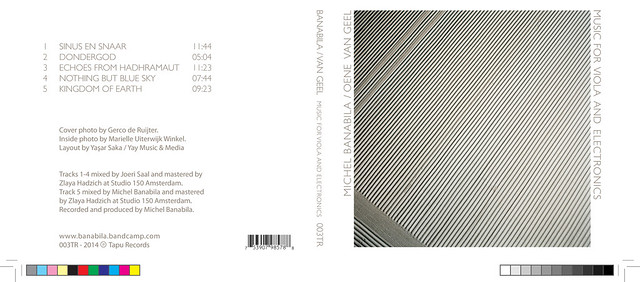
Cover photo by Gerco de Ruijter.
Inside photo by Marielle Uiterwijk Winkel.
Track 1-4 mixed by Joeri Saal and mastered by Zlaya Hadzich.
at Studio 150 Amsterdam. Track 5 mixed by Michel Banabila.
and mastered by Zlaya Hadzich at Studio 150 Amsterdam.
Released September 4, 2014.
Michel Banabila:
Doepfer A-100 analog modular system, Logic Pro (1,2,3,,4 & 5) , ocarina & voice (5)
Oene van Geel:
Viola (1,2,3,4 & 5) , Stroh violin (5)
Bruno Ferro Xavier da Silva : Bass (3)
Werner : Voice (5)
All tracks composed by Michel Banabila & Oene van Geel.
A special thanks to Dennis Verschoor and Pieter Moermans for advise on the Doepfer A-100.
We would like to acknowledge financial support from the Fonds Podiumkunsten for the realization of this album.
On Music for viola and electronics II, Banabila and Van Geel explore further into their neo classical mix of viola improvisations, ambient textures, minimal compositions, and modular experiments.
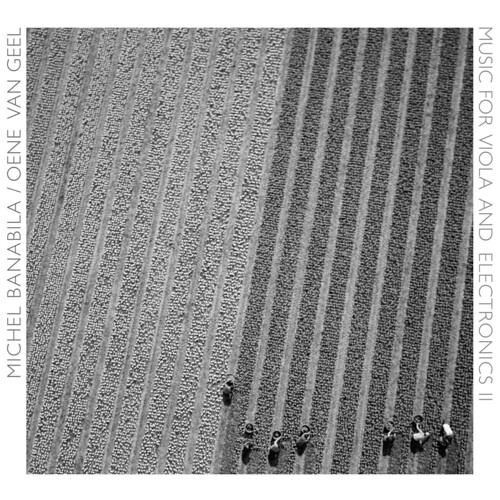
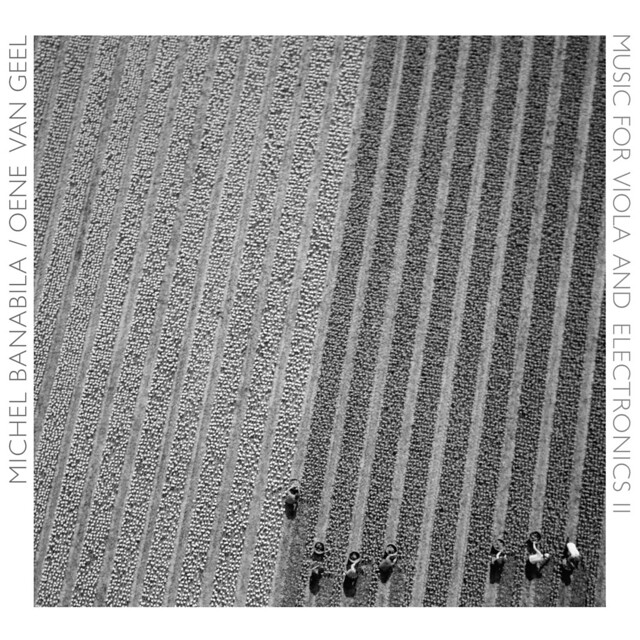
After their collabs on 'Music for viola and electronics', (2014) Michel Banabila and Oene van Geel decided to continue their recording sessions, again combining viola with electronics. This time they invited Eric Vloeimans on trumpet, Keimpe de Jong on contrabas clarinet, Joost Kroon on drums, Emile Visser on cello and Radboud Mens for Ableton programming. Emile plays in Zapp String Quartet with Oene, Eric performed live with Oene and The Nordenians, Eric and Michel worked before on their award winning album VoizNoiz 3, Keimpe and Michel performed together in a theatre play, Radboud and Michel worked on ZoomWorld and many other projects together. The artwork is again by photographer Gerco de Ruijter.
Quotes, reviews:
THE SQUID'S EAR:
Diverse. This is the first word that must be used in describing Music For Viola And Electronics 2. Electronic musician Michel Banabila and Violist Oene van Geel explore more territory on one album than seems possible. They touch on free jazz, industrial beats, drones, noise, groove jamming, and compositional elements reminiscent of Steve Reich and even Andrew Loyd Webber. Yet, the album flows nicely and is amazingly coherent despite the wide variation. Another word one might use is "cinematic." The album feels at times like a soundtrack. That's not to say that it is destined to be used as background music, but that the music has a narrative. It is a dramatic, emotional journey, similar to cinematic music. This quality is most pronounced on the third track, "Vleugels". This piece begins with looped melodic viola, reminding the listener of the classical minimalism of the 1960s. It then weaves its way into a rich emotional composition with thick tonal harmonies. When electronic drum beats ramp up to a rock feel, the music begins to sound like a modern Broadway musical. On the other end of the spectrum is the final piece on the album, which features chaotic string punches and layered synth tones, which sound like insects buzzing. Somehow it all falls together into a coherent musical statement. Every musical destination flows seamlessly into the next in a natural and logical manner. The end result is a beautifully pleasant album. Rarely are experimental albums this accessible; Banabila and van Geel have put together an album that can be fully appreciated by any avant-garde fan, without enraging their neighbors. (Christopher Mandel)
CAFE ACOUSMATIC:
Michel Banabila’s and Oene van Geel's Music for viola and electronics I & II is wonderfully immersive, expansive, and intimate. If there’s one word that comes to mind, over and over it’s cinematic. The listener is swept up in a storyline that’s played out by two superb actors, in this instance, Oene von Geel’s viola and Banabila’s electronic counterpoint of mood and temperament. The overall result is a sonic dance that fills the space and the heart. Let’s encourage these two superb musicians keep collaborating. Highly recommended for headphones. Five stars. (Don Hill)
AMBIENTBLOG:
After they met when working together on Cloud Ensemble, Michel Banabila and Oene van Geel extended their collaboration which resulted in 2014’s “Music for Viola and Electronics“.
Both were so very enthusiastic about the new musical world that they had opened up, that they kept working on “Music for Viola and Electronics II“, which is released this month. Judging by the (strikingly beautiful!) aerial landscape photography of Gerco de Ruijer on the cover, their collaboration will probably not end here: the crop of the (geometric) landscape on the Volume I cover photo is only partially harvested – by hand, line by line… a difficult, strenuous, but most rewarding work. Even for those that follow Banabila’s work throughout the years, “Music for Viola and Electronics” is a bit hard to classify, because it’s different from most of what he did before. At least, it seems that way: according to Michel himself, it’s simply a next step – the logical consequence of everything he has done in the past.
The combination of Michel’s modular Doepfer electronics with the warm natural sounds of Oene’s viola opens up completely new perspectives. In some way, it is easier to say what this music is nót, than to describe what it ís. It cértainly is a roller coaster of emotions and dynamics, which probably is demonstrated best at the beginning of Volume I: after opening with the carefully restrained, almosts zen-like “Sinus en Snaar”, complete turmoil kicks in with the aptly named “Dondergod” (“Thunder God”). It’s probably best to put on safety belts before you play this on high volume! “Music for Viola and Electronics II” builds further on the same concepts as the first volume. Some extra musical guests are introduced on several tracks: Keimpe de Jong (contrabass clarinet), Joost Kroon (drums and metals), Emile Visser (cello), and Eric Vloeimans (trumpet). There are some distinct references to somewhat less ‘experimental’ musical territories. For instance, “Kino Mikro” and “Vleugels” both have a rather cinematic arrangement (the latter taking a surprising turn midway with frantic drumming backed by a string section that sounds like a metal band – a surprising moodswitch effectively breaking the constraints of minimalism). Unlike many other albums that choose to focus on one particular atmosphere, these albums are more like a kaleidoscope of fragmented emotions. This may be a bit confusing at first listen, but it proves to be very rewarding if you carry through and keep listening ! (Peter van Cooten)
UTILITY FOG (FBI Radio):
Music for viola and electronics II follows the same sonic path as part 1 but adds further instrumentation: bass clarinet, cello, trumpet, drums. It's not all experimental modular electronics & extended techniques, but nor is it all lush world beats & string melodies – it strikes a nice balance. They've both stayed on my virtual turntable a lot recently. (Peter Hollo)
VITAL WEEKLY 976:
In the last six months they worked on new music, again using their set-up of electronics, which is for Banabila a doepfer A-100 analog modular system, radio, logic pro and keyboards (the latter on all tracks) and Van Geel plays viola and 5 string violin. I was highly surprised by their release, and obviously the second release is not the similar surprise (it could be, of course, but it just isn't) but it further explores the nature of violin playing and electronics. 'Chaos' comes close to the world of free jazz, with some wild electronics too and a fine orchestral ending. In the longest piece, 'Hephaestus', that also is the opening they set the compass to all things drone like and atmospheric, along with the modular synth cracking up like rainfall and some sparse drumming, making it all a very intense piece. A top-class release of some highly exciting electronic music meeting classical instruments. (FdW)
SUBJECTIVISTEN / HET SCHADUWKABINET:
Vorig jaar maakt Michel Banabila samen met violist/componist Oene van Geel, van huis uit een jazzviolist met een hang naar Indiase muziek, kamermuziek en improvisaties, de cd Music For Viola And Electronics. Ze brengen op biologerende wijze beide werelden samen in een bijna buitenaardse setting met elektronica, neoklassiek en experimenten. Genoeg reden om door te gaan en nu deel 2 hiervan te presenteren. Banabila (Doepfer A-100 analoge modulaire synthesizer, logic pro, keyboards) en van Geel (altviool, 5 string viool) krijgen hierbij rugdekking van Keimpe de Jong (contrabas, klarinet), Joost Kroon (drums), Radboud Mens (programmeringen), Emile Visser (cello) en de gelouterde Eric Vloeimans (trompet); een waar sterrenteam. Het levert een nog meer diepgravend en fascinerend hoorspel op vol subtiele details. Op organische wijze maken ze spannende dwarsdoorsneden van ambient, neoklassiek en meer abstract elektronische muziek. Deze worden gelardeerd met wereldse, rock- en jazzelementen en bijzondere bijgeluiden. “Vleugels” is zo’n prachtig voorbeeld, waar dat alles op zinderende wijze samenvloeit. Maar ook de andere 4 tracks zijn van een onbeschrijfelijke klasse en schoonheid. Arvo Pärt, Tapes, Nils Økland, Hector Zazou, Robert Normandeau, Giacinto Scelsi, David Darling, Loren Nerell en de “Made To Measure” serie, dat is waar ik vooral aan denk bij deze innovatieve beauty. (JanWillem Broek)
POLYPHONIA:
Holenderscy artyści znów połączyli swoje siły, czego efektem jest druga część album „Music for viola and electronics II”. Obaj panowie (Michel Banabila i Oene van Geel) spotkali się po raz pierwszy w trakcie współpracy przy projekcie Cloud Ensamble (2013). Rok później ukazał się ich pierwszy longplay, pt. „Music for viola and electronics”. Mniej znaną postacią jest Oene van Geel, więc dodam, że to skrzypek i kompozytor pochodzący z Amsterdamu. W jego kompozycjach można znaleźć wpływy muzyki indyjskiej, jazzowej, kameralistyki czy wolnej improwizacji. Udziela się w takich formacjach jak Zapp 4, Estafest, The Nordanians, Art of the Eyebrow, The Splendorkestra. Na „Music for viola and electronics II” pojawiło się znaczniej więcej różnych brzmień instrumentów (trąbka, kontrabas, klarnet, perkusja) niż na pierwszej części. Banabila, tak jak poprzednio, zajął się warstwą elektroniczną i systemami modularnymi, a van Geel odpowiada za smyczkowe partie. Płytę otwierają („Hephaestus”) mroczne, chłodne i potężne drony, które z czasem „topnieją” i niepostrzeżenie zamieniają się w oniryczne ambientowe melodie zanurzone w improwizacji. Podobnie też jest w bardzo ciekawym utworze „Chaos”. Zaskoczenia doznacie zaś w „Vleugels”, gdzie ni stąd ni zowąd przenosimy się bliżej klimatu Islandii spod znaku Sigur Rós. W „Radio Spelonk” miesza się nastrój filmowy z elementami słuchowiska i improwizacji. Całość zamyka nagranie „Kino Mikro” – minimalistyczne, ziarniste, lekko zaszumione, z kolei w samej końcówce ten fragment staje się bardziej dynamiczny, zwłaszcza dzięki partiom van Geela. Artyści po raz kolejny pokazali, że mocną stronę ich materiału, jest improwizacja. (Łukasz Komła)
A CLOSER LISTEN:
Music for viola and electronics II is a very good album, an improvement over its already solid predecessor. But with one small adjustment to the track sequencing, it becomes a great album. In its current order, the timbres grow louder and busier until the bursting centerpiece, “Vleugels”. After that, a severe drop in energy ensues. But move the last two tracks to the front, and one can appreciate the artistry of the entire set. Expanding on the palette of the previous installment, Michel Banabila and Oene van Geel have added a bevy of complimentary instruments, including violin, trumpet, bass clarinet and drums, along with additional programming. A number of invited guests makes the moniker seem incomplete. There’s even an uncredited, fragmented female voice on “Radio Spelonk,” which reminds one of the recent experiments of Felicia Atkinson. This subtle, creeping piece deserves to be heard first, as it is both the softest track and the largest surprise. The sparse nature of this piece is echoed on the subsequent track, “Kino Mikro” (“Micro Cinema”), but this time the viola receives the chopping treatment, poking holes in muslin cloth until it finally breaks through. A slight air of menace pervades the piece, thanks to the slow pace and the pleading cries of the trumpet. But in its final three minutes, the piece turns to glitch, more than doubling its pace and throwing the windows open to the rest of the band. As it stands, the album ends in a repeated vinyl pop, but we like it better when the pop leads to another menacing piece, the current album opener “Hephaestus.” To refresh our readers’ memories, Hephaestus was the blacksmith of the gods: hammer, anvil, fire. One can imagine him in his workshop as the thirteen-minute piece unfolds. Drones and static surges contribute a near-industrial flavor. The vinyl pop reappears in the third minute, flickering like tongues of flame. In the seventh minute, the dark drums arrive like the pounding of steel, accompanied by the sizzling sound of falling stars. This is magnificent, restrained work, a mature blend of instruments and influences unlike anything on the preceding album. At this point, it’s fair to reiterate our opinion that these albums need stronger, more allusive titles; Hephaestus would have been perfect. Imagine now that the album is building toward its conclusion. The new penultimate track is “Chaos”, an all-out assault on the senses. van Geel’s viola is no longer content to remain in the shadows; the artist establishes his presence early, guiding the other instruments through a maelstrom of swirling sound. The track implies chaos by injecting sudden electronics, but ironically, the music itself has form, repeating themes on its way to a structured conclusion. The melancholic middle is its finest section, a yearning whisper that follows the hoarse throat of a scream. And then, “Vleugels” (“Wings”). On this piece, the talents of the entire cast are showcased, and the music reaches for the stratosphere: out of the muck, out of the mire, out of any earthbound tragedy or terror. The opening moments sound like a rising flock, the first third like darting, and the final five minutes like soaring. With only 3:35 to go, the drums take the piece beyond the clouds. The sun spills forth, glistening in rainbows on the oil of the flock’s wings. And finally, for the first and only time on the album, pure strings, pure beauty, pure joy. Yes. This is where we want to end. (Richard Allen)
KINDAMUZIK:
Texturen en timbres vallen uit de lucht in een glooiende vallei waar een ietwat onheilspellende disharmonie en dissonantie schuurt. Wringende minimale muziek wordt geduwd richting geluidskunst-achtige exploraties die spetteren en knarsen. Ze barsten van de bezieling en vooral van zeggingskracht. En dan niet van het afgekloven clichésoort dat onder de stoplap 'cinematisch' gevangen moet worden, maar juist in temperamentvol flikkerende en hakkelende stop-motion, waarbij je op de achtergrond de projector meent te horen ratelen. De forte van Banabila, Van Geel & Co. is de warmte die eerstgenoemde uit zijn modulaire Doepfer weet te krijgen en die spruit ook uit de nerven van Van Geels klankkast. Daarmee is dan ook zo ongeveer de enige gemene deler van deze fragmenten aan borrelende, kwieke inspiratie gemarkeerd. Stiekem loop je het risico niet verder te komen dan het absoluut fenomenale openingswerk 'Hephaestus', dat urenlange repeat opeist. En daar is nu eens helemaal niets mis mee, al zou je dan wel voorbijgaan aan de nodige brille waarin freejazz, postrock en folk langskomen. (Sven Schlijper)
GONZO CIRCUS #127:
Rotterdam staat bekend als de stad van het harde werken. Ook in de muziek kennen ze dat adagium. Naast artiesten als Machinefabriek en Lukas Simonis, heeft ook Michel Banabila een hoge productiviteit. Een half jaar na zijn samenwerking met altviolist Oene van Geel op 'Music for viola and electronics', is er al weer een vervolg hierop. Dit keer krijgt het duo hulp van een aantal gastmuzikanten als Eric Vloeimans, Emile Visser of Radboud Mens. De CD opent met een ambientachtig stuk van twaalf minuten waarop Banabila en Van Geel een duel 'uitvechten' met geknetter van electronica en dramatisch aanzwellende viool geluiden. In het experimentele 'Chaos' laten de gasten zich horen en het zijn vooral de altviool en cello (Emille Visser) die zich doen gelden. 'Vleugels' begint minimaal en het lijkt een stuk voor strijkers te worden. Halverwege zit er echter een verassende break waarna het veranderd in een rocknummer. In 'Radio Spelonk' speelt Banabila met afgeknipte stemsamples te midden van minimale electronica. De laatste track klinkt als een soort allegaartje, maar draagt zeker bij aan het constante hoge niveau van de avontuurlijke muziek op dit album. (Oscar Smit)
FLUID RADIO:
Music for viola and electronics II with Oene van Geel is an expansive, stylistically omnivorous affair. The influence of acousmatic approaches to composition makes its presence felt. As its title suggests, “Music for viola and electronics II” is the second duo album from Banabila and van Geel, though as a description of the music it’s a little bit misleading: a number of other acoustic instruments feature on the album, such as trumpet, clarinet, drums, and cello, and there’s additional programming from Radboud Mens. The treatment of electronic sounds is very typically acousmatic, with rapid cuts and leaps across the stereo field. The acoustic instruments, however, tend to be arranged in ‘modern classical’ configurations, with rhythmic and melodic motifs drawn from folk complementing the lush block chords and some very nice pizzicato work from the viola. The beats laid over the top by drummer Joost Kroon took me by surprise, but made more sense with each listen. Not usually my thing, but an enjoyable listen nonetheless. (Nathan Thomas)
INACTUELLES:
Michel Banabila et Oene Van Geel récidivent. Après le volume I paru en 2014, voici le volume II sorti depuis peu, avec une nouvelle superbe photographie aérienne de Gerco de Ruijter en couverture, et quelques musiciens en renfort : la clarinette basse de Keimpe de Jong sur le titre 2, Joost Kroon à la batterie et aux métallophones en 3, Radboud Mens à la programmation ableton en 5, Emile Visser au violoncelle et Eric Vloeimans à la trompette sur les titres 2, 3 et 5. "Hephaestus" donne le ton de cet opus, sorte de poème électronique sombre, mystérieux, caverneux. Ne sommes-nous pas dans les forges de Vulcain / Héphaïstos ? Sur fond de drones, l'alto de Oene Van Geel tranche, zèbre l'espace sonore de grands coups d'archet. L'arrière-plan devient régulièrement incandescent, animé d'une respiration obscure. Des aigus déchirent la trame d'un incendie qui couve, ça grésille, crépite, quelque chose de monstrueux émerge peut-être. Le morceau est une plongée dans les mystères de la matière, une odyssée imaginaire d'une grande puissance. Peu à peu, la caverne se peuple de multiples vecteurs sonores, le marteau s'abat avec une régularité infernale, de quoi réjouir les amateurs de musique industrielle ou expérimentale, je pense aux albums d'Annie Gosfield parus chez Tzadik par exemple. La coda est paradoxalement une longue traînée sidérale, une échappée de la caverne démolie sous les coups de marteaux-piqueurs électroniques. Magnifique et impressionnante ouverture ! Le début de "Chaos", le deuxième titre, est trompeur. La langueur mélancolique du chant de l'alto , déjà menacée de bruits bizarres, est explosée après une percussion sourde du clavier. Tout s'écroule, se lézarde, l'alto dérape, des percussions multiples, des pizzicatis, perturbent la mélodie, qui sourd quand même entre les fragments de blocs sonores, les transcende. Pièce oxymorique, écartelée entre démantèlement et mélodies d'une suavité ravageuse. C'est absolument superbe, d'autant que la clarinette basse apporte son contrepoint profond au chant sublime des ténèbres apparu après la première partie destructrice. Comme des trompes électroniques répondent au déhanchement orientalisant du violoncelle, tandis qu'un discret pizzicato rythme le mystère des surgissements, que la trompette se déchire dans des aigus extrêmes. "Vleugels" ("Ailes") nous emporte au pays des oiseaux chimériques, sans doute les oiseaux du lac Stymphale, aux ailes et aux plumes d'airain, de bronze. La composition est pulsante, à dominante d'aigus brefs imitants les cris d'oiseaux, puis le violoncelle apporte ses graves majestueux, et l'on s'envole en beauté majeure sur des draperies de claviers synthétiques et une batterie déchaînée. Comme quoi électronique et lyrisme peuvent faire bon ménage ! Toute la fin est d'une suavité incroyable...Mais "Radio spelonk" est un retour à la cave - c'est le sens du néerlandais "spelonk" - aux mirages, aux hallucinations, peuplée de brefs échantillons de voix, animée d'apparitions sonores fugaces, que le violon d'Oene vient unifier par des phrases énigmatiques. On est ici entre musique concrète et pure musique contemporaine. "Kino mikro" se fait alors la voix d'un Destin sibyllin, articulé en courtes respirations où apparaissent tantôt l'alto, le violoncelle, la trompette (on songe fugitivement à Jon Hassell) sur un arrière-plan de disque qui gratte, de particules nuageuses. Le dernier tiers est plus syncopé et en même temps plus explicite avec un retour de mélodies entêtantes, un côté manège infernal, puis tout se défait, retourne au silence. Une deuxième collaboration très réussie pour ce voyage imaginaire passionnant de bout en bout, musicalement splendide. (Dionys Della Luce)
NIEUWE NOTEN:
Het zijn ook dit keer weer samenwerkingsverbanden waar Banabila voor kiest, waardoor ieder werkstuk zijn eigen kleur heeft. De eerste is Music for Viola and Electronics, deel 2. De voortzetting dus van de samenwerking met altviolist Oene van Geel (zie hier de recensie van deel 1). Alleen hebben de beide heren op dit album nog een aantal extra muzikanten uitgenodigd, waardoor alleen het eerste nummer: ‘Hephaestus’ door Banabila en Van Geel samen is gemaakt. Hephaestus was bij de oude Grieken de god van het vuur, de metaalbewerking en de beeldhouwers. Welnu de muziek klinkt als afkomstig uit een smederij. Een lang uitgesponnen soundscape, door Banabila gecreëerd middels logic pro en keyboards, wordt door Van Geel op regelmatige basis aangevuld met subtiel altvioolspel. Samen leidt het tot een spannend en soms beklemmend geheel. De stoom slaat er vanaf. Ook ‘Chaos’ is van het beklemmende soort. De donkere klanken van de contrabas klarinet, bespeeld door Keimpe de Jong, in combinatie met de noise die Banabila voortbrengt, contrasteren op bijzondere wijze met de strijkersmelodie die Van Geel produceert. Een melodie overigens die associaties oproept met de muziek uit de Balkan. Het levert een wat onwezenlijke combinatie op. Bijzonder is ook het pizzicato moment aan het eind van dit stuk dat langzaam uitdooft. ‘Vleugels’ heeft in aanvang een aan minimal music verwante opbouw. Totdat uit deze gelaagde en repeterende melodie, de altviool en de cello, oftewel Oene van Geel en Emile Visser, in een klassiek aandoend duet tevoorschijn komen. Na dit intermezzo wordt het tempo opgeschroefd. Ja, het krijgt vleugels en neemt de luisteraar mee op een hemelse reis.‘Kino Mikro’ is wellicht wel het bijzonderste stuk op dit album. Het is dwars, verstorend, maar vol met onverwacht harmonische momenten. Zoals de bewerkte altvioolpartij op driekwart van het nummer. De klanken van de Roma, maar dan elektronisch bewerkt. Het geeft een apart effect aan dit nummer. (Ben Taffijn)
HYPNAGOGUE:
The best, most accessible piece here (for me) is “Vleugels,” and I can’t get enough of it. It enters on string spirals, with Emile Visser’s cello arriving to add his repeating notes to van Geel’s as they build into a charming minimalist space. When Visser takes the lead, the mood shifts, the sound gets richer, and the sense of moving toward something is strong. Enter Joost Kroon’s drums, absolutely launching the piece with a blast of pure rock energy. The strings head straight for your heart at this stage; it’s truly that stirring. Aside from “Vleugels,” it does take some tolerance for experimental music to appreciate Music for Viola and Electronics II. It challenges the listener, but the complexity of sound and the chemistry at work tempers the rougher edges. (John Shanahan)
CANHDONGAMNHAC:
After their collaboration on ‘'Music for viola and electronics'’, (2014) Michel Banabila and Oene van Geel decided to continue their journey with “Music for viola and electronics II” (2015). They continue their immersive, expansive direction and also focus on a cinematic, minimalist approach. The electronics still provide a dramatic approach while the viola arrangement is close to modern classical and drone music. I can also hear some very interesting influence from industrial/jazz from this album. The combination between viola and electronics has always caught my interest. I appreciate the beauty and creativity of these two albums, as well as the effort of Michel Banabila and Oene van Geel. I look forward to hearing more about their collaboration in the future. (Nhung Nguyen)
ANTHEM ALBUMS:
Ouvir trabalhos como Music for Viola and Electronics II é algo recompensador. A interação entre Michel e Oene, que se conheceram na Cloud Ensemble, entusiasma pela dificuldade dos temas propostos e como estes são tratados com a densidade necessária. O tempo é estendido e seu andamento lento provoca suspense, pela repetição dos sons eletrônicos, um verdadeiro drone, para inserções pontuais do violino que, mesmo tentando evadir essa estrutura inicialmente rígida, constrói em sua “prisão” versos verdadeiramente bonitos. A relação é expressa cuidadosamente, em uma lenta comunhão que muitas vezes se extravai para além da percepção conceitual. É um tipo de música que trabalha intensamente com conceitos, mas está primariamente fundada no que essa imersão extracorporal realiza com nossas percepções. Até a “entrada” na parte mais sinistra do disco, que se inicia na segunda faixa, é uma transição de modo que o último período da música se estenda para outra- estamos claramente falando de prolongamentos.
Os eletrônicos densos e meditativos de Michel são perfurados quando combinados para a viola, mas não que um tenha necessariamente função oposta ao outro. Muitas vezes a viola cria o ambiente também enquanto a parte de Michel soa alto, revelando influências do dito dark ambient e do noise. De alguma maneira, é como se toda a potência de ambos os espectros tentasse ocupar o espaço do outro, não em forma de disputa, mas uma compreensão de possibilidades e o que tais atritos podem efetivamente criar. É certamente algo que soa além da simples soma entre sons mais “clássicos” dessas diferentes abordagens. Provavelmente releva um espaço novo sempre que tal atrito é criado, e por desconhecermos (e só estarmos dispostos a compreender o que nos viciou), foge de nossa apreensão.
Banabila disse recentemente que essa é apenas uma evolução natural de sua música, mas é engraçado como um músico de seu gabarito, que desde 1986 vem produzindo um corpo sonoro muito importante para a música eletroacústica, considera “evolução natural”. Obviamente mais minimalista que suas outras obras e menos seletivo (nesse álbum, por exemplo, não há inserção de nem um sample), também abdicou de uma espécie de multi etnicismo para algo que se aproxima às relações de causa-consequência.
Esse minimalismo focal, porém, cede muitas vezes espaços para construções cinematográficas. A última faixa lembra muito ambientes interioranos, e Oene nos apreende com violino e viola, onde as cordas variam entre o livre improviso e música clássica contemporânea. Essa música é exemplo da dualidade e confiança da dupla- nela, ambos os espectros realizam o livre improviso e uma construção mais metódica. Não consigo capturar o conceito de Music for Viola and Electronics II, talvez pelo que mencionei no primeiro parágrafo; a dificuldade em reconhecer novos territórios quando uma arte de vanguarda aponta elementos tão limítrofes. Curiosamente, quando os músicos convidados são introduzidos, que toda essa elaboração fica mais assimilável.
Passando por toda a obra Banabila (onde Spherics talvez seja a mudança completa de rumo) temos contrariedades inerentes à visão complexa que um artista tem da música. Onde as expectativas possíveis se equivocam a cada lançamento. Mas repito, é um corpo sonoro poderoso. Eu indicaria Spherics como o melhor ponto de inserção, porque os direcionamentos de seus discos nos deixa sempre a sensação de algo realmente “grande”. Onde meros “formatos” são dissolvidos em prol de um caráter mais honesto em um lugar que as sensações ficam em primeiro plano. Ou seja, um compromisso radical com sua visão de vida, que indubitavelmente está em cada segundo de suas músicas. (Henrique Barbosa Justini)
Released March 20, 2015.
Mastering by Zlaya Hadzich.
Cover photo by Gerco de Ruijter.
Inside photo by Michel Banabila.
Layout by Yasar Saka / Yay Music & Media.
Recorded, mixed and produced by Michel Banabila.
All tracks composed by Michel Banabila and Oene Van Geel.
Michel Banabila:
doepfer A-100 analog mod. syst. (2, 5), radio (4), logic pro and keys (1, 2, 3, 4, 5)
Oene van Geel:
viola (1, 2, 3, 4, 5) and 5 string violin (4)
A special thanks to Dennis Verschoor and Pieter Moermans for advise on the Doepfer A-100.
We would like to acknowledge financial support from the Fonds Podiumkunsten for the realization of this album. / 004TR - 2015 ℗ Tapu Records.
Fluister Festival - Banabila & Van Geel live / Concertzender Utrecht 2016:
Banabila & Van Geel Live Concertzender 28 december Fluister Festival 2016.