Showing posts with label minimal. Show all posts

Monday, 16 June 2025

Through Global Frequency

(A poem largely composed from the titles of some of my recordings made over the years.)


'Shockingly beautiful ' (Randall Roberts / In Sheeps Clothing HiFi)


'A beautiful work of poetry set in to ambient which creates a warmth like no other!'
(Hidden Sounds London).


We are in a crowd, 

we are in noise - 

can you still hear, 

my trembling voice 


Speaking in tongues, 

where old meets new, 

in made-up language, 

just to reach you 


Sounds arrive, 

from an unforgettable place, 

receiving the whispers, 

of a vanishing trace 


Ancestors murmur, 

in global frequency, 

our alien voice, 

rises secretly 


From echo transformations, 

to bones of the past, 

a signal buried - 

but built to last 


One moment in time, 

still out of place - 

may our ears tell us, 

where we are in space


12th Isle


  Also available on METALABEL


Sunday, 10 May 2020

Michel Banabila, Stijn Hüwels, Cok Van Vuuren: One Moment In Time

Apple Music playlist (April 2020) 'Pure Meditation'

Tuesday, 23 April 2019

Mix for RedLight Radio

SET LIST 04-18-2019 RedLight Radio

1. Field Rec intro
2. Feldman & Brown - Durations IV.1
3. Jan Jelinek - What You Should Know About Me
4. Oren Ambarchi and Martin Ng - Surfacing Edit
5. New Composers from St. Petersburg - Astra
6. New Composers from St. Petersburg - Something Is Happening With Me
7. Erik Honoré - Procession
8. Central African Pygmies - Bow-Harp & Vocal
9. Michel Banabila - Melodica & Bells (Red Light Radio Remix)
10. Michel Banabila - The Lost Drone Tape 3
11. Fennesz & Sparklehorse - Music Box Of Snakes
12. Alva Noto - Xerox Spiegel
13. Thurayya Qaddura - Fatakatu Lahziki (Time Wept) - mixed -
14. Jon Hassell - Last Night The Moon Came Dropping Its Clothes In The Street


Visit The Something Something

Thursday, 4 April 2019

Uprooted


UPROOTED

Peter Hollo: cello (1,2,3,4,5)
Alex Haas: synths & electronics (3)
Gareth Davis: bass clarinet (1,2,3,4,5)
Stijn Hüwels: guitar & electronics (3,4,5)
Oene van Geel: viola and stroh violin (1,3,5)
Gulli Gudmundsson: el. bass, double bass and ebow (1,2,3,5)
Michel Banabila: soft. instruments, sampler, electronics (1,2,3,4,5)

DRAGONFLY
SOLAR WAVES
COLLECTOR
BREAKING POINT
BREATHE


The Uprooted Orchestra.

“Orchestral.” The word’s an adjective, certainly, an unambiguous one. It depicts amassed instruments working in synchrony according to a fixed document prepared in advance. But what if “orchestral” were uprooted? What if “orchestral” referred to what we heard, not how it was recorded? What if “orchestral” welcomed electronic instruments not just into the pit, but into the compositional process?

For that is the sound of Michel Banabila’s Uprooted, this album of beautiful, striated, patient music — patient on the surface, deep with turmoil underfoot. When bass clarinet and harmonium rise above a misty string section halfway through “Breathe,” that’s orchestral. When woodwinds trill and pulse against piano on “Dragonfly,” that’s orchestral.

Over the years, Banabila has made his share of experimental ambient, wherein future roots cultures are foreseen through a low-tech looking glass. On Uprooted, the tech is transparent. The album has touches of Fourth World, most notably on “Collector” and "Breathe," but Uprooted is orchestral, full stop.

It’s also an album entirely forged of material sampled by Banabila from improvisations by invited musicians. Those samples were then constructed into a whole by Banabila, layered sinuously rather than triggered on a rhythmic grid. The fixed orchestral document here is the recording, and it marks the close of the composer’s efforts, not the start of the performers’.

Marc Weidenbaum.
San Francisco, March 2019.

Cat. nr. 026TR
Limited edition / 150
Design by Yasar Saka
Artwork by Gerco de Ruijter
Alex Haas courtesy of Sonicontinuum
Mastering by Marlon Wolterink / White Noise Studio
All tracks composed & produced by Michel Banabila

2019 © + ℗ Tapu Records / banabila.bandcamp.com


Downloads: 4-9-2019. Limited edition CD: 4-16-2019.

HEADPHONE COMMUTE
A CLOSER LISTEN
AMBIENTBLOG

Thursday, 13 December 2018

Michel Banabila & Willem Cramer: Texture Syndicate EP

Texture Syndicate from Michel Banabila on Vimeo.

Michel Banabila & Willem Cramer first worked together in Chi (1984-1986), (banabila.blogspot.com/2016/08/chi-original-recordings_6.html) and later in East Meets West (1990-1991), (banabila.blogspot.com/2016/08/east-meets-west-hoy-babo-hoy.html). In 1996 they collaborated with Chris Grem making a score and performing live in a dance production by Lieber Gorilla. (banabila.blogspot.com/2016/08/lieber-gorilla-visioenen.html) This 2018 EP is their first new collaboration in 22 years. Viola sounds were contributed by Oene van Geel and violin sounds were contributed by Salar Asid. Willem Cramer is a composer & multi instrumentalist, living and working (like Banabila) in Rotterdam. www.willemcramer.com/audio


Willem Cramer: ebow guitar, bass, synthesizer & programming.
Michel Banabila: sampler, turntable & synthesizer.
Oene van Geel: viola (1 & 2).
Salar Asid: violin (2).

Composed, recorded, & produced by Michel Banabila & Willem Cramer. Artwork by Michel Banabila.
A special thanks to Marc Weidenbaum for suggesting the album title.

Mix & mastering by Willem Cramer.
This release is a download only.
2018 © Tapu Records.
Cat. Nr. 025TR.

Thursday, 1 March 2018

Just Above The Surface

Listing boats, field recordings, loops, polyrhythms and sonic incantations: Just Above The Surface - Michel Banabila (new album) .


Artwork Gerco de Ruijter.

A CLOSER LISTEN: The title is an inversion of expectations; we’re used to reading the words, “just below the surface.” Sound artist Michel Banabila has been defying classifications for years, and here he does so once again. The irony is that while the attention is drawn to the sounds that lie just above the surface ~ tape noise, viola, bass clarinet ~ there’s still a lot going on just below. Take for example the dolphin noises in “The Ripple Effect” (which we believe to be Gareth Davis, sounding like a dolphin), providing imagery to accompany the track. Tumbling bass and boat samples reflect the ripples while the clarinet imitates the unpredictable nature of the sea. In the final minute, slow drum hits add drama while unexpected melodies emerge from the aether. Gerco D. Ruijter’s cover art is a perfect match for the music. Ruijter’s art finds abstraction in concrete images, typically snapped from above. In this image one might see the aforementioned ripples, but one might also see mountains or frosted plains. The same is true of Banabila’s music. “Snake Bite” features Oene van Geel and Salar Asid on viola and violin. For the first half, it sounds like an elegy until Banabila turns it into a dirge, exposing the dual nature of death and remembrance. The title “Out of Sync” highlights the friction, as loops circle at different speeds, the howls of dogs set against the cries of gulls. Again a breakthrough arrives in the final minute, a sudden synching akin to the saying that even a broken clock is correct twice a day. If we had a year-end list featuring track titles, we’d certainly include “Cassettes and Polaroids in the 21st Century.” Just as a great cover can draw attention to great music, a great title can prompt one to take a spin, especially when the track is instrumental. (In contrast, consider the title “Dreams” – not a Banabila track! – and ask yourself, “Am I curious about that song?”) Before we put the digital needle down, we’re already thinking about lost formats, engaging in pleasant nostalgia while wondering what the piece will sound like. Thanks to Marcin Barski’s contributions, it implies the abraded memories of bygone days. Once again, Banabila revisits the ripple effect, as if the entire project had been recorded on a quiet boat. The waves have died down. Just above the surface, all is calm. (Richard Allen)


Michel Banabila at OCCI, Amsterdam, 2017.

AMBIENTBLOG:
Just Above The Service, his latest release, is released almost casually, unannounced. It is a digital only release, which is an understandable choice at this time – but I feel a bit sorry for those that treasure all things physical… this music deserves to be available on a less ethereal level. Because of the music, but also because of the stunning cover artwork by Gerco de Ruijter. There are six long tracks (most around 9 minutes) and a (shorter) closing track which is taken from a Disquiet community release dedicated to Bassel Khartabil (coder and open-source advocate from Syria, imprisoned and executed). With the exception of the last track, the material for this album was created with parts and fragments made for a live performance. Banabila’s flawless wide-screen production is created with the help of some friends he worked with before (Oene van Geel, viola, Salar Asid, violin). As far as I know it is the first time that Gareth Davis adds his bass clarinet sound to Banabila’s music: on the shuddering opener The Ripple Effect. Martin Barski adds tape sound on Tapes and Polaroids in the 21st Century (great title!) It is fascinating how easily Banabila navigates between different kinds of styles and moods, even within the span of one single track. From emotional, melancholic to abstract experimental, from subdued calm to a threatening tribal rhythm that makes your palms sweat. And the transitions never sound forced. (Peter van Cooten)


Gareth Davis

IRREGULAR CRATES:
Why isn’t Michel Banabila more famous? This is music which deserves large cinema screens and at least as much press as Nils Frahm and his Erased Tapes cronies! I’ve a few of Banabila’s releases – I came across them through my buddy Rutger Zuyderveldt aka Machinefabriek – very attentive Netherlands sound designer folks the pair of them – and their four albums together. Banabila is more overtly ‘musical’ than Rutger, and these tracks present a nice worldview and warm electronics which you could imagine being on reel to reel tapes. And one thing I like about Michel’s work is that it’s not afraid to be emotional at times… very warm. There’s impressive instrumentation and very good mixing. Listing boats, field recordings, loops, polyrhythms and sonic incantations. I wrote that without even reading the title ‘Just Above The Surface’ and it does what it says. I feel I am following a day, perhaps a few, from boats on surfaces of different depths. It’s as if we start on marsh land with all the rich birdlife and move through passages where we witness – from a distance – activity far out at sea. Can’t always make out the horizons as the album but I’m happy at this surprise release and the journey I’ve been on. Ferry to Holland please (Dr. Chris Dooks)

WSZYSTKIE STANY SKUPIENIA:
Ziennik pokładowy = doprawdy straciłem rachubę ile już czasu płyniemy po tych nieznanych człowiekowi wodach. mapy pokładowe od wielu mil zdają się zgodnie rozrysowywać nasze wielkie zagubienie. jaskółczy niepokój koją skutecznie ataki lekkiej agarofobii i przyjemnej maligny słonecznej - błogosławiony udar wielkiego dnia. kapitan nasz, Michel Banabila, wydaje się mieć w tym wszystkim plan specjalny. od początku wędrówki zapętlał wrażenia z prawdziwie marynarskim sznytem, roztaczał wokół chmury dźwiękowych wrażeń, mieszał syntetyczne z prawdziwie organicznym. a wszystko to miksturą doświadczenia, co każe się sobie poddać. i niby leżę w miejscu, lecz kołyszę się coraz śmielej. dryfuję, niemącony życiem, prosto w egzotykę kolejnego Wdechu.


Released January 10, 2018.

All tracks composed & performed by Michel Banabila.

Gareth Davis: bass clarinet on The Ripple Effect.
Additional sampled parts contributed with kind permission by:
Oene van Geel (viola) and Salar Asid (violin) on Snake Bite.
Marcin Barski (tapes) on Cassettes and Polaroids in the 21st Century.

Title of track 4 borrowed with kind permission by Bence Meijer.
Some of the material in this album was originally made for an ableton live performance at the Haperende Mens Festival, Amsterdam, December 2017. haperendemens.nl

Track 6 added with kind permission of Rupert Lally & Marc Weidenbaum. Source: afutureincommons.bandcamp.com/album/a-future-in-commons-a-tribute-to-bassel-khartabil


1-5 recorded in December 2017, Rotterdam.
6 recorded in August 2017, Rotterdam.
Mastering: Marlon Wolterink / White Noise Studio
whitenoisestudio.com

This album is a download only.

2018 © Tapu Records / 021TR

Saturday, 6 August 2016

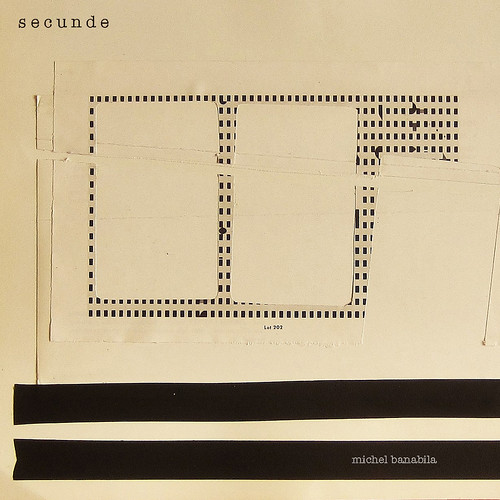
Secunde

On Tiny Elements I played a few simple melodies and chords with sine tones, with lots of spaces in between, using a sampler without samples loaded. I invited Oene van Geel to play the chords and melodies on the viola and Keimpe de Jong to play some lines on clarinets.

The other 3 tracks are basically made from this first track.

Everything on Drawing with Closed Eyes are sampled parts from track 1, pitched down with a sampler. Drawing with closed eyes is a game I enjoy playing with my daughter. It's exciting to see what we come up with, never knowing exactly what images will reveal themselves ;-) Doing track 2 with the sampler felt a bit the same, since I cannot read or write notes and had no clue what I was actually doing. Just trusted my ears to find the combinations of chords that would go nicely together. So one mix was a fifth lower and one mix was an octave lower. I placed these two lowered files below the original in Logic and subsequently composed the track by cutting from all three files. Sounds were added on the melodica and I asked Keimpe to play saxonett and Ilya Ziblat Shay to play sound effects on contrabass.

Deep Dream is track 2 treated with Michael Norris software. The whole track was transposed lower again, using a sampler. After that I took an improvisation by Oene van Geel, originally played (but not used) on track 1, tuned it down and mixed it together with this track.

For Audio to Midi I asked Radboud Mens to use Ableton Live to transform the audio from track 2 into midi notes, as I was curious about the info of the lowered chords from the sampler. But the mix was too complex and the result of the midi notes sounded a bit weird. However, these midi notes played by piano samples on higher speed, using an extremely short decay inspired me to make one last track with it. Finally I added some field recording and melodica sounds.


Released February 18, 2016.

Oene van Geel: viola, violin.
Ilya Ziblat Shay: contrabass.
Michel Banabila: sampler & melodica.
Keimpe de Jong: clarinet, bass clarinet, saxonett.

Artwork by Harold McNaron.


A special thanks to:
Joeri Mol for general feedback.
Yaşar Saka for edits in melodyne.
Radboud Mens for spectral edits in Izotope & a. live audio to midi.

Secunde: Tiny Elements / Drawing With Closed Eyes from Michel Banabila on Vimeo.


[1,2,4] arranged by Michel Banabila.
[3] arranged by Michel Banabila & Oene Van Geel.

SoundMagic Spectral used on track 3 is a freeware suite of 24 Audio Unit plug-ins by Michael Norris.

Composed & recorded by Michel Banabila.

Oene van Geel
Keimpe de Jong
Ilya Ziblat Shay

SECUNDE CJD REMIX:


2016 © Tapu Records / 015 TR.

Untitled

Feedback + Modular + Radiowaves


KINDAMUZIK:
Drie namen voor een beestje waarin drie gezichten te horen zijn; feedback - check!, modulaire synthesizer - check!, radiogolven - check! Heb je nog helemaal niks aan als je geen idee hebt wat het is, wat je ermee moet en hoe je er een beluisterbaar album of twee van moet maken. Enter: Michel Banabila; jarenlange ervaring in de achterzak, experiment hoog in het vaandel en dan vooral: nieuwsgierigheid naar waar de apparatuur hem voor verrassingen plaatst. Op deze twee albums jakkert Banabila dartel over knopjes; hij lijkt druk in de weer met podmeters en patchkabels. Een antenne plukt fragmenten statische ruis en stukjes uitzending uit de ether. Her en der knarst iets. Een pruttelende golftoon komt op; feedback dreigt nadrukkelijk platwalsend een mengpaneel zonder inputs over te nemen. Gaat daar nu de deurbel? Of is het toch een op hol geslagen brokje elektronica ergens in de keten? Banabila weet verdraaid goed wat hij kan doen, maar laat ook los. Hij weet speels vrijheid te behouden en daardoor ademen de platen een letterlijk experimenteel musique concrète-achtig aura. Verknipt en elektroakoestisch, maar ook vloeiend en verhalend; geïmproviseerd, maar ook met een hand aan de trapleuning van de rode draad. Naar beneden stuiken is er dan ook niet bij. Machinerie komt tot leven en blijkt ook gewoon een speelgoeddoos. De spullen moeten bijeen gebracht worden als op een assemblageband; tegelijk ben je wel eens wat kwijt, verkeerd neergelegd, file kwijt of corrupt, bandje terugspoelen. Drievlakselektronica kan een steriele bedoening worden waarin kille processen zich achter glimmende frontjes afspelen, met daartussen een bult spaghetti aan kabels. Ongetwijfeld zal het in Banabila's studio zo'n zooitje geweest zijn aan apparaten. Zijn absolute meerwaarde bestaat eruit dat hij de machines tot een warmbloedigheid wekt; modulaire processen en golven uit de lucht in interfererende botsingen brengt, luistert en die feedback weer kunstig inzet. En dan kom je ergens in de hoek van 8 bit-achtige gekte, Asmus Tietchens, Felix Kubin en ook de grootmeesters van de GRM, zoals Guy Reibel, uit. Nederconcreet; een nieuw genre ? (Sven Schlijper)

FEEDBACK + MODULAR + RADIOWAVES:


Untitled

Released October 14, 2015.

Michel Banabila: feedback, A-100 modular, WebSDR, fieldrecording.

Edited and recorded in Logic Pro.

Cat. nr. 011TR.
2015 © + ℗ Tapu Records.

FEEDBACK + MODULAR + RADIOWAVES II:


Released November 12, 2015.

Michel Banabila:
feedback, A-100 modular, monotron, webSDR, fieldrecording, tape.
Radboud Mens:
sinewaves, clicks and bass (3)
Edited and recorded in Logic Pro.

1,2,4,5,6 composed by Michel Banabila.
3 composed by Michel Banabila & Radboud Mens.

Cat. nr. 012TR.
2015 © + ℗ Tapu Records.

FEEDBACK + MODULAR + RADIOWAVES III:

AMBIENTBLOG
FMR3 is the third and final (?) release in Michel Banabila‘s series of experiments in combining the three sound sources from the title. It opens in quite a radical way with a loud synthetic gong that immediately draws full attention, followed by a minimal machinelike noise – an industrial meditation. Modular synths are very fashionable, but too often the musical results only interesting for the nerdy buttonfreaks using them – there’s too much of ‘what does thís button do??’. But not in Banabila‘s hands. By using clever combinations of different sources, and by careful manipulation, his compositions – even the most minimal ones – get a fascinating cinematic tension. In Banabila‘s diversely branched discography, the FMR series is connected to his electronic works (like The Department of Electrical Engineering releases) and thus quite a lot more experimental than his works for theatre, his jazz-related outings or his crossovers with world-music. Michel Banabila still manages to combine the best of a lot of musical worlds in his rapidly growing discography, and there’s no sign of slowing down! (Peter van Cooten)


released January 31, 2016.
Michel Banabila:
feedback, A-100 modular, webSDR, soft.synths, sampler, fieldrecordings.

Lukas Simonis:
guitar - feedback sounds [1,3,6].

Track 2 recorded live at Noodlebar, PinkPank Rotterdam, January 23th, 2016.

Cat. nr. 014TR.
Edited and recorded in Logic Pro.
Composed by Michel Banabila.
2016 © + ℗ Tapu Records.


GONZO CIRCUS:
Michel Banabila is een veelzijdig componist. Hij werkt bij voorkeur met synthesizers waar hij een duizelingwekkende veelheid aan klanken uit tevoorschijn peutert. Hij schrijft voor ensembles, verwerkt omgevingsopnamen in zijn muziek. Die muziek is te horen bij films en, vanzelfsprekend, in optredens - onder meer in het bloeiende en groeiende circuit van analoge elektronica. Dat laatste genre komt volop aan bod op ‘Feedback + Modular + Radiowaves II’, zoals de titel al aangeeft het tweede album in een serie waarvan onlangs ook een derde deel verschenen is. Banabila zet contrasterende geluiden tegenover en achter elkaar: onstuitbaar verende toontjes, een langgerekt dor raspen, bliepjes en bloepjes, een opgewekt borrelen, een langs het verschiet snellend fluitje. ‘Basic Patch’ is een onafgebroken stoet van klankwagentjes, het ene nog maller en merkwaardiger dan het volgende. Soms heb je het gevoel een immens losbarstend onweer te horen naderen, maar dat wordt al snel onschadelijk gemaakt met ritmes waar het hoofd onwillekeurig glimlachend op gaat meedeinen. Het afsluitende ‘Radio Sky’ ontvouwt zich langzaam met nasaal trillende bassen en rondspokende fluittonen, alsof hij je na al die opwinding en variatie toch wat rust wil gunnen. (Rene van Peer)

3 from Michel Banabila on Vimeo.

47 Voice Loops

Proposal for a soundart installation consisting of a room with 47 speakers.

47 loops of my voice, some time stretched, each loop a different length. For every loop there is one speaker. The volume of each track for each speaker changes by an automated mix. The starting point of each loop is random, and as they move towards each other, endless new combinations can occur.


Inspired by / dedicated to Cornelius Cardew & The Scratch Orchestra 'The Great Learning' - paragraph 7 (1971)


AMBIENTBLOG:
As the title indicates, the basic ingredients for these tracks are 47 layered and looped recordings of Michel's own voice - and since each loop has a different length the result is a choral work in endless variations in which the same combination of fragments will hardly ever be repeated (a generative music principle often used by Brian Eno). Although the originating process and the philosophical fundaments may differ, those of you that paid attention at experimental music history class will probably immediately recognise "The Great Learning, Paragraph 7 " as composed and performed by Cornelius Cardew and the Scratch Orchestra in 1971 - a piece that Banabila acknowledges to be one his greatest musical influences ever. The result is "MltVz9" - a mesmerisingly calm vocal ocean, whispering messages probably only your subconscience will understand... But it does not stop there. The second version of this track repeats the process but with the loops heavily processed and mutilated, feeling like washes of instrumental noise unrelated to human vocal. Next, the album concludes with a mix of these two versions, in which the voices seemingly struggle with their unnatural counterparts. Throughout his work, Michel Banabila has always been experimenting with all aspects of the human voice. This album is his ultimate hommage to the composer and the musical score he has admired for all his life. (Peter van Cooten - 04-18-2013).

SUBJECTIVISTEN:
"Een biologerend hoorspel dat zich als een ambientalbum laat beluisteren." (JanWIllem Broek)


001TR © Tapu records
Released April 9, 2013
michel banabila: voice