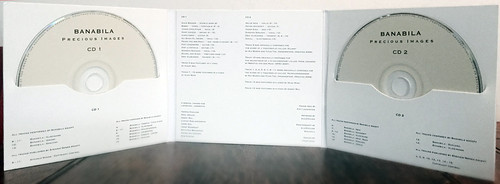
Unfolding Michel Banabila´s Precious Memories is like opening up an old chest filled with old wind-up toys and brightly-wrapped candies. You want to bury both arms up to the elbow, pulling out one trinket after the other to play with, admire, or slowly savour before moving on to the next. Subtitled ”Datafiles 1999-2008”, this double omnibus includes tracks selected from all his releases on Dutch label Steamin´ Soundworks beginning in 1999. He is a man of many genres, or perhaps more correctly, he is trans-genre, for there seems to be no particular base from which he prefers to work. He just composes. And collaborates eagerly, to the listener´s delight. The first disc displays a range that is giddily eclectic and includes a few clunky little pieces that could have served as interludes on a latter-day Tom Waits record (”Wonderful Mistakes”, ”Sorokin Blues”, ”One for the Road”), a song in collaboration with Moroccoan Sufi singer Bahia El Idrissi, a hyperreal tribal dance ("Do Something About It!"), edgy electro-funk (”Heavy Gravity”) and a groovy bit of space age bachelor pad jazz showcasing Eric Vloeimans´ trumpet (”Damned”). Some of the programmed rhythms will remind you of Brian Eno´s ”Another Green World ” or ”Nerve Net”, like ”A Strong Sense of Urgency”. Central to most of the pieces is the human voice, often dozens of them threaded together to create a kind of dada poetry. What unites them all is the way Banabila tweaks and crafts them just enough to defy expectations. Take for example the slow and laidback late night jazz session ”A Virtual Meeting”, with muted trumpet, bass clarinet and fleet-fingered piano cruising prettily above quiet squonks and squeeks. A perfectly executed hybrid. Although Banabila appears to relish combining the digital with the acoustic, there are some nice, purely electronic pieces featured as well, like ”Low Pulse + High Noiz”. There is little on the first disc you could call "ambient", except perhaps the two pieces which conclude it, in particlar the beautiful ”Voiz Recycled”, with its smattering of Jon Hassell-like horn, that I would happily hear extended far beyond its eight-and-a-half minutes. Disc two contains music made for television and theatre in 2008. Banabila claims not only to be inspired by photography, video, film and theatre, but also to ”think” in terms of transforming visual impression into sound. Perhaps necessarily, most of the pieces featured here do not have the strong personalities of many of the tracks on its sister disc, since they were intended to complement a foreground. But there are moments when the music is too engrossing to merely take in passively. The sweet meanderings of ”Migrations” is an exciting musical journey that could very well represent a trip around the globe or at least reflect how the globe is setting up shop in and influencing Europe. It´s a true mongrel and all the more loveable for it. Another attention-grabber, "Ears Tell Us Where We Are in Space", showcases Dutch guitarist Anton Goudsmit and is hauntingly introspective, with a slight Jaco Pastorius patina. The album ends with a slow ambient descent beginning with ”Night”, continuing with ”Crime Scene” – hardboiled noir again featuring the sensitive, muted monochromes of Vloeimans - and the dark ”A Moody Guy´s Audible Dream” with Polish electronics wiz Zenial. As an introduction to the work of Michel Banabila it is laudable. As a retrospective over his recent career, it is something for him to be very proud of. (Stephen Fruitman).
Distinctly cinematic and frequently unnerving, each of the seven tracks is gripped with a noirish sense of isolation and the chill of a lingering menace. Some tracks bridge the gap into dub and others make use of record-popping glitches.
BOSTON HERALD:
Michel Banabila, who grew up in the Netherlands, has produced a lush blend of atmospheric soundscapes on his latest disc, "Spherics." Banabila, who handles the samples and edits, works with Piet Lichtveld (guitar); Jorien Muste (violin); and Bobby (cymbals, drone). The quartet combines to produce a lush, soothing orchestration that is parts Brian Eno and Snoop Dogg. Each of these seven movements is distinct, though they all have a pair of similarities: they are brooding and hypnotic. "Suma 4 - Blue Mix" is the album's standout. It features a slow beat and warm percussion. The track flows with slow and even layers. At the opposite end of the spectrum is "Worm-Jazz," a heavier, noisier track. Most of these cuts have a low end that powers the trance-like beat. "Tic Tac" settles into a funky groove after opening with some nifty organ. At points, some of these tracks take on a drone-like quality that can be jarring if not downright troublesome. "Science Freak" features a grinding that sounds like (but is not) a record needle on mucked-up vinyl. It's a little too jarring. With "Spherics," Banabila has created a backing track for everyday life. It is moody and low and it hardly ever fails to satisfy. (Michael J. Ryan).
SAN FRANCISCO EXAMINER:
Dutch native Michel Banabila experiments with the darker side of ambient to manipulate psyches with his atmospheric compositions. Nerves frazzle and moods swing. A rich sci-fi soundtrack for primitive living ! Caution: This album could scare children and small animals.
Spherics release BOUDISQUE RECORDING: 2001, August 23th. (NL)
Spherics release TONE CASUALTIES: 2002, July 15th. (USA) Steamin' Songs Publishing.
Released August 23, 2001.
Michel Banabila ; sampler & edits.
Piet Lichtveld ; guitar.
Jorien Muste ; violin.
Bobby ; cymbal-drone.
Composed and produced by Michel Banabila.
KINDAMUZIK:
De Rotterdamse muzikant Michel Banabila is niet in een hokje te stoppen. Was hij in zijn Voiznoiz serie nog druk bezig met de menselijke stem en analoge instrumenten. Op Spherics II is daar niets meer van te merken. Hier geen jazz of gitaar, maar pure electronica. Met slechts een synthesizer en een sampler zijn negen uiterst boeiende sfeerstukken in elkaar gezet.
Net als voorganger Sperics I is de sfeer dreigend en donker. Toch voegt Banabila extra dimensies toe aan zijn muziek. Met name op de momenten dat drumbeats de electronische geluidslagen versterken, dwingt Banabila tot luisteren en is wegdommelen geen optie. Op de momenten zonder pokerslagen of basdrum heerst er dreiging en word je gehypnotiseerd op een manier die Rasti Rostelli ooit voor ogen moet hebben gehad.
Hoogtepunt is het prachtig opgebouwde ‘Low Pulse & High Noiz’ waarin Banabila een waar meesterwerkje neerzet. In acht minuut dertig gaat hij van klein en intiem naar groots en extatisch. Het enige wat je nog mist na dit nummer is applaus. Hopelijk volgt dat deze zomer op Lowlands… (Patrick van Engelen)
KWADRATUUR:
'De frisse synthmelodiên die her en der opduiken in deze plaat, proberen tevergeefs op te boxen tegen de sombere teneur die algemeen wordt aangehouden. Naarmate de CD vordert, worden alle mogelijke vormen van opgewektheid zonder meer de kop ingedrukt. Subtiliteit en loomheid blijven heersen, maar dan op een erg onrustige manier. Het bombastische 'Wolves in Sheeps-Clothing' benadrukt dit nog het sterkst. Verre, zwaar overstuurde gitaren dramatiseren op new wave achtige wijze de noodlottige bascadans. Deze schapen zijn duidelijk hulpeloos aan hun moordenaar overgeleverd. Dankzij het voortreffelijk opbouwende 'Low Pulse & high Noiz' – veruit het beste nummer van de CD – wordt de draad wel even terug opgepikt. Kille machinale eenvoud groeit uit tot een warme en heerlijke climax...' (Johan Giglot)
'Cards On The Table' was a Staalplaat release in 2000 by Michel Banabila, Hannes Vennik & Bobby.
"Cards On The Table" is not a traditional music release.
The material was brought in by three players at their numerous meetings. It involves no instruments, but everybody brought sound material on tape, which was collated and collaged on harddisc.
By using a deck of playing cards, various combinations and mixes were proposed. To enhance the idea of shuffling a deck of cards, the CD was presented as a"shuffle" mode CD.
Everytime you play this a new total composition arises.
During talks the three discussed the atmosphere, rather then rhythms, chords or melodies.
In just under 19 minutes you get 28 tracks which quickly change
atmospheres, locations. Rhythms come and go, resulting in a frentic
collage. Edited with great care with lots of surprises.
This CD was a 5" CD with 3" playing. The print is all on the jewel case
(like Staalplaat's Material Series) and also comes with a Mexican
table cloth and of course a playing card.
Electronic. CD &12inch vinyl (Pork Recordings / Tone Casualties)
WAX MAGAZINE:
A thoroughly engaging, amusing and charming debut from new Pork signing Michael Banabila. Slightly more random than your usual Pork output, but still retaining the essential ingredients, Banabila strings together 20 soothing skunk funk oddities that delight and bemuse in equal portions. Tender beats, oddball samples, live instrumentation and vocal snippets weave together to make a warming abstract picture, one of those ones that looks good whichever way you hang it.
(Nov 2000)
ALL MUSIC GUIDE:
The strength of this fascinating found-sound pastiche will be enough to send fans of musique concrete, advanced turntablism, and trip-hop scouring the import bins. Most of the material that comprises these 20 tracks comes from field recordings of human voices speaking, singing, declaiming, and arguing, all of them reportedly made in the streets, buildings, and train stations of Holland and Yemen. The recordings are cut up and pasted together in sometimes eerie and frequently downright funky ways: the result sometimes sounds like a collaboration between Jon Hassell and African Head Charge (as on the danceable "Do Something About It" and the even more Hassell-ish "Sorokin Blues") and sometimes like a cross between Tricky and the Residents (as on the darkly funky and melodically quirky "Chickensoap). On "Where?" the snippets of speaking and singing are arranged by pitch, and the result is a sort of techno version of hocketing; it's an example of medieval technique meeting 21st century technology, and the result is wonderful. This is an exquisite album by an artist who deserves much wider recognition. (Rick Anderson).
KORTEX Electronica:
VoizNoiz c'est avant tout, des collages sonores mélodiques et urbains. C'est aussi Michel Banabila et une fantastique collaboration de musiciens de Rotterdam. L'ensemble ainsi crée s'aventure dans des territoires voisinants l'Acid Jazz, le trip hop et la peinture sonore abstraite. VoizNoiz c'est un film qui défile dans notre tête : l'ambiance cinématographique propagée par les différentes pièces de l'album s'impose à notre esprit et nous fait voyager un peu partout à travers le monde à l'aide d'un fond musical riche doublé de différents échantillons hétéroclites. Chaque mouvement est pourtant bien clair, et on peut facilement associer les pièces à tel ou tel événement fictif. VoizNoiz est un album diversifié qui bénéficie pourtant d'un solide fil conducteur qui permet à l'auditeur de ne pas se perdre au sein des myriades de sonorités exploitées par Michel Banabila et ses copains. Une belle et amusante expérience auditive. (Yanik Trudeau)
ALTERNATIVE PRESS:
Post modern assemblage of found sounds and vocal fragments. Sound collage can often be more conceptually interesting than listenable. Michel Banabila handily avoids this on the unclassifiable VoizNoiz. He uses location recordings from Holland and Yemen, along with live guitar, voices, bass and percussion to construct what he calls "urban sound scapes". Banabila assembles riffs from found-sound and vocal fragments into oddly conversational grooves. This approach recalls Coil, but without their inward-looking menace. VoizNoiz is every bit as post-modern as the work of today's DSP-terrorists, but it's a much easier listen. (Kent Williams).
COOL AND STRANGE MUSIC:
Holland's Michel Banabila is one of those rare musicians who can take an avant-garde conception and turn it into a highly entertaining work of art. VoizNoiz is a masterpiece of found sounds and voices used rhythmically and humorously with obvious nods to Jean Michel Jarre's classic collaboration with Laurie Anderson, Zoolook, without the dark psychological edge, and Coil, without the homo-erotic magick. VoizNoiz is an update of the genre into contemporary trip-hop, with touches of exotica and Asian house music. There is a slight Carribean edge in some parts, but the jack-hammer editing of the sound montage is so intense that by the time one is able to digest an influence, it has been replaced by something completely different. Think of a tropical island version of Tipsy, only more cartoony (which is no surprise as the executive producer is the legendary animator Gabor Csupo.) Though the CD is separated into 20 different tracks, I defy anyone to figure out which one is which without looking at the track indicator. It's like a lovingly unified vision of schizophrenia done Tex Avery style. (Wilhelm Murg)
PITCHFORKMEDIA:
The Pork folks discovered Banabila and flourished this remarkable disc with "Mono/Metro," a holler-sampling-and-contorting fragment of genius that Moby would stomp Fairfield County, Connecticut into the subsoil for. (Paul Cooper).
EARPOLLUTION : VoizNoiz 2
Michel Banabila has an ear for sound and a pulse which runs through his fingers. Taking a nearly limitless number of samples, he finds a common pulse that they gravitate towards, and produces groovy - nearly trip-hop style - songs. There are no voices other than the stolen ghosts which become halting, tripping verse-chorus-verse arrangements under his skillful manipulation. "Voiz IX" is a wheezing street orchestra, a tiny marching band made up of two kids banging on trash cans, one over the hill tuba (worked over by a much younger player with a decent set of lungs), a couple of single-stringed guitars, a kid with an old radio sporting exposed wiring, and a drum major with a three-dollar megaphone. Banabila reworks all these elements (and the echoes which their street performance leave rattling down the long alleys) into something else, something a little less than a recognizable tune and more into a musique concrete abstraction. At the other end of the spectrum is the following track, "Speak," which hums along at 144 bpm, hammering and jabbering beneath a cut-up vocal track that speaks in starts and stutters. Like all good pastiches, you find comfort in the recognizable elements and thrill in their unexpected juxtaposition. Banabila's work on VoizNoiz II is a soundtrack to the urban chaos which is the overwhelming reality of city living. (Mark Teppo)
INK 19 : VoizNoiz 2
Considering you can give a whole group of people a fancy recording studio, tons of personal attention and pampering and they create audible crap, artists such as Banabila are all the more wonderful. His sophomore release in the Urban Sound Scapes series, Banabila recorded VoizNoiz 2 completely in his home studio. Mainly, sounds are used to create "words" of sound that speak in the language in which we hear. There is a world flavor, a little "trip-hop" label floating around, and one visionary artist behind every moving track. Creepy, loungy, jazzy, sexy, mysterious, fun, and artsy, this is for anyone who's bored with their current musical interests. This album makes you open so many musical doors. A few standout tracks: "Heavy Gravity," the bouncy, tribal "U Beat," sporadic "Speak," and "To The Angels." Learn a new language with Banabila, the language of sound. (Vanessa Bormann)
ALL MUSIC GUIDE : VoizNoiz 2
The second volume in Banabila's series of Urban Soundscapes is much like the first, a kaleidoscopically funky collage of found sound, aural experimentation, trip-hop beats, and promiscuous sampling. As on his first effort, a willfully bizarre sonic design sense is constantly counterbalanced by a thoroughly populist approach to the groove ‹ there is nothing on this disc listeners won't be proud to dance to and nothing that won't catch them by surprise if they listen hard enough. A few examples: the creaking door, splashing water, and severely altered voices on "Voiz VIII" that rub sensuously up against metallic guitars and a thick, slow groove ; the lurching, Tom Waits-ish "One for the Road," with its turntable-scratching and locomotive sample; and the slow-building "Dinoh Dinoh," which starts off with layers of deeply tweaked voice samples and slides into an irresistible mid-tempo breakbeat with horn section and Hammond organ. The avant-garde is at its best when it's funky, and funk is at its best when it's avant-garde. (Rick Anderson)