
Michel Banabila, born 1961, is a sound artist, composer, and producer.
Banabila releases music since 1983 and has produced musical scores for numerous films, documentaries, theatre plays and choreographies.
This album collects 11 songs from his early years, released on tape, vinyl EPs or limited CD editions: beautiful minimal loop-based electronica, neo-classical pieces and ambient drone music.
A true discovery! (Bureau B)

Early Works: Things Popping Up From The Past (2016 reissue) liner notes:
Numerous threads run through the music of Michel Banabila, whose contemporary work ranges from adventurous electronic cross-breeding of chamber instrumentation, to industrial rhythmic sampling, to outward-bound modular synthesis, to deeply elegiac drones.
What is remarkable about this collection of early pieces is just how many of Banabila’s ongoing fascinations had already taken root, when he was barely half his current age. The child apparently is not merely the father to the man; he is also his music tutor. In particular, there are extended sequences of neoclassical loveliness and dense patches of Fourth World exploration that, matters of specific equipment aside, could have been recorded yesterday. Except that they weren’t.
The classical activity heard here constitutes a romantic attachment to the Old World, filtered through a contemporary sense of proportion. Banabila’s piano, its atmospheric gestures bringing to mind the proto-minimalism of Erik Satie, echoes with a disarming simplicity. The sweetness of the tune masks his determined compositional focus on loop-like repetitions, on the ever so slight variations between pulses, on training the listener’s ear to hear inside the notes, between the notes, to be receptive to matters that are more tactile than tonal. The melody could easily be an additional hundred years old — except for fact that the refined patterning is something that likely only could have been pursued in light of the music of Michael Nyman and Philip Glass. Similarly, a solo harmonium performance circles around a song that could be a maudlin street-corner serenade in a benighted district of a nameless Eastern European city — and yet it has a self-consciousness of the instrument’s breath-like quality that marks it, however subtly, as modern music.
And, of course, this isn’t modern music. This is music several decades after the fact. It is no longer of our time. The equipment on which it was made, notably an early sampler, was limited in various ways, key among them the relatively circumspect set of capabilities, especially in terms of memory storage, and the lack of received performance techniques. The equipment was simple and it was new, and neither factor limited Banabila’s ambition; to the contrary, the tools concentrated his imagination.
If the classical pieces represent the Old World as framed by the new, then the more recognizably “electronic” work here is likewise most at home in a fictional place, an idealized zone. That zone is a quiet neighborhood in the Fourth World, to borrow Jon Hassell’s terminology, one in which digital tools render something that is, for all its technological dependency, ultimately a form of folk music — an otherworldly folk music for another time. At that time and in that place, a percussive guitar figure lends momentum to ethereal synthesized choral vocals. Fidgety percussion plays amid a fierce but restrained guitar line (there are echoes of Laurie Anderson and Adrian Belew). An ambiguous and elongated drone, thick with subliminal activity, beautiful in its toxic anxiety, suggests dire activity on the horizon.
And yet the horizon wasn’t dire. Quite the contrary, what was ahead for Banabila was a long string of releases, a healthy and well-documented career in which so many of these individual threads have been provided time and space to have entire records dedicated to their pursuit. This album of archival works is a document, and what it documents is the continuity inherent in Banabila’s music. It is a map in musical form, and the path it traces is one that crisscrosses back and forth between the Old World and the Next.
Marc Weidenbaum / Disquiet
San Francisco, California
February 2016.
Reviews:
THE RECOUP:
Michel Banabila is a prolific Dutch experimental composer, specializing in minimalist electronica. He’s quite prolific, too; on Discogs, he has fifty-two albums to his credit, and that’s just to his name, not including his side projects. His work has a unifying sound: the beauty of ambient music, as performed by modern technology. Bureau B’s new compilation Early Works does an admirable job of introducing Banabila to the listener unfamiliar with his work. For the most part, the compilation goes straight for the gentle, delicate work. It’s hard not to drift off into a netherworld of pleasantness when listening to “October” and “The Call.” Harold Budd is recalled on “Piano 1” and “Piano 2,” as well as on the gorgeous “Harmonium Improv 1” and “Harmonium Improv 2,” which tempers the delicateness of piano with a hushed, cooling drone that never imposes any heaviness on the listener. Not that he can’t do drone well; “The Lost Drone Tapes” show that he’s a master of that style, too; the sounds and atmosphere is heavy, but it’s never short of beauty. Banabila has released a lot of music over the course of three decades; one can find his work scattered throughout the internet, via Spotify, Youtube, and other sources. But Early Works offers an excellent look at the man’s early years, where it’s obvious that Banabila realized quite early that he is a gifted, talented composer. This music serves as a perfect escape from the heat of an oppressive Summer sun. (Joseph Kyle)
OEDIPE PURPLE:
Alors que son album Marilli figure en bonne place dans notre wishlist, le label Bureau B a eu la bonne idée de ressortir du placard les splendides harmonies de Michel Banabila. Une invitation à la rêverie qu’on ne peut refuser, à l’instar du premier morceau October… On repeat.

NOWAMUZYKA:
Niemiecka wytwórnia Bureau B opublikowała płytę z bardzo rzadkimi utworami Michela Banabily, które powstały na początku jego kariery. Nie tak dawno recenzowałem podwójny album „Tapu sampler” holenderskiego muzyka, kompozytora i producenta, będący zbiorem jego nagrań z lat 2007-2015. Można potraktować ten materiał jako szybki sprawdzian z tego, co w ostatnich latach prezentował Banabila. W przypadku longplaya „Early Works / Things popping up from the past” cofamy się w czasie jeszcze dalej gdzieś w okolice lat 80., ponieważ z tego okresu pochodzą kompozycje. Przypomnę, że artysta aktywnie działa od 1983 roku. Na „Early Works…” znajdziemy jedenaście różnych utworów nie tylko pod względem brzmienia czy użytych instrumentów, ale przede wszystkim pokazujących szeroki wachlarz możliwości tego utalentowanego kompozytora. W takich fragmentach jak „Harmonium improv #1/improv #2” i „Piano No. #1/#2” można doszukać się – jak trafnie zauważył Marc Weidenbaum w swoim tekście – inspiracji twórczością Michaela Nymana oraz Philipa Glassa. Ale na tym krążku są też takie nagrania, które mogłyby być zarejestrowane dosłownie wczoraj, choćby dwa ambientowe „Des Traces Retrouvées I, No. #4”, „The Lost Drones Tape No. #2” i bardziej eksperymentalne „The Workers”. W lekko etnicznym „A Sharp Silver Line” z kolei mamy solówkę gitarową Banabily bliższą stylowi Adriana Belewa z King Crimson. Niesamowite jest to – jak już wspomniałem – że większość utworów z tego zestawu nie kojarzy się z kiczem lat 80., nawet nie ma przepychu jeśli chodzi o syntezatory, a jak już są to raczej w aranżacjach z pogranicza minimalizmu i muzyki klasycznej. Mimo dużej rozpiętości stylistycznej, „Early Works/Things popping up from the past” słucha się jako całości. (Łukasz Komła)

NORMAN RECORDS staff review:
This a collection of early works by Banabila, he has previously done all sorts in his career including theatre. But don’t let that put you off as this collection has some moments that you’ll want to spend time visiting if you are a fan of Michael Nyman or Philip Glass. The opening ‘October’ could in fact come from any number of Woo LPs. Elsewhere we get off kilter piano compositions (‘Piano no 2’), Eno/Fripp-like instrumental scapes with wobbly guitar solos (‘A Sharper Silver Line’) and all manner of variations of oddball drones. Some of it’s disconcertingly angular and some is truly mesmeric, ‘The Call’ in particular runs Eno’s ‘Another Green World’ fairly close in faded 70s nostalgia synth. A delightful collection, your ears will thank you for it. 8/10 (Clinton)
UNDERBELLY:
Need I still explain Michel Banabila? After his recent period of increased productivity, the “Retro-Market” has found him, too. After all, he started releasing records in 1983, so the time is here. This album collects 11 songs from his early years, released on tape, vinyl EPs or limited CD editions. There’s a great variety – besides the kind of electronic loop-based world-ambient that made him so well-known – like two improvisation pieces on harmonium, found back in his enormous collection of tape recordings, never published before, some minimalist Satie-esque piano pieces, and more abstract, textured drones. The overall feel is that of intimacy, withdrawal and sweet melancholy. (Mariette Groot)
VITAL WEEKLY 1037:
'To hear his first album 'Marilli', go to Michel's bandcamp page and listen to an extensive remix version of it, and you can hear the various traces of the original, but reworked, by Banabila and his many friends; it's a highly recommended remix project'. 'For a real glimpse of old days, Bureau B just released this eleven song release, with four previously unreleased pieces, and pieces from 'Des Traces Retrouvees I' and 'Des Traces Retrouvees III' and 'The Lost Drones Tapes'. These pieces no longer work using ethnic voices (as was apparent on 'Marilli'), but purely dwell on Banabila's own playing of the Roland S10 sampler, piano, found objects and harmonium. Banabila's music these days may take many forms, from modular synth to electro-acoustics to ambient, in these old days it was all about moods and textures'. 'The music is dreamy and meditative but never borders on the tired clichés of new age; it sounds naive but after some thirty years it is also surprisingly fresh. It's minimal music and it always remains very playful, never very strict'. 'These eleven pieces are a highly varied bunch but it makes great sense putting these together. Not just because it shows the many sides of Michel Banabila (even back then!), but also because it makes such a great listen. Always atmospheric but with delicate touches on offer, this is a great CD. (FdW)
GONZO CIRCUS 134:
Sinds 1983 overstelpt de Nederlander de mensheid met releases, die meestal behoorlijk interessant zijn. Voor deze collectie ‘vroeg werk’ dook Bureau B de archieven in en komt naar boven met nummers uit ‘Des Traces Retrouvees I’ (1984), ‘Des Traces Retrouvees III’ (1987) en ‘The Lost Drones Tape (1988). Cassettes en een mini-album die al jaren onvindbaar zijn en hier worden aangevuld met vier onuitgegeven nummers die verder bouwen op wat de ooit verschenen stukken al lieten horen. En dat is een Banabila die ondanks de beperkingen van het materiaal in die tijd, inventief aan de slag ging. Harmonium improvisaties, stijlvolle ambient, en piano muziek die erg klassiek aandoet, wisselen elkaar af. We denken meteen aan Erik Satie, vroege Philip Glass, en Michael Nyman, mede door het filmische karakter van de meeste nummers. Banabila zit er dan ook niet om verlegen muziek te componeren die in allerlei disciplines kan worden gebruikt. ‘Early Works / Things Popping Up From The Past’ is een mooie aanvulling op het fysiek beschikbare werk van veelzijdig artiest Banabila (PB)
 POLYPHONIA:
Holenderski muzyk Michel Banabila nie daje nam odpocząć! Płyty z jego najnowszymi nagraniami ukazują się bardzo często. Okazuje się jednak, że również w przeszłości Michel miał wiele do powiedzenia na polu muzyki elektronicznej i nie tylko! Krążek „Early Works / Things Popping Up From The Past„, ukazał się na płycie CD, ale także na płycie winylowej nakładem wytwórni Bureau B, która to wytwórnia specjalizuje się właśnie w wydawaniu wczesnych prac muzyków, którzy utrwalili swoje miejsce na niezależnej scenie muzycznej. Tak, aby mieć to już za sobą, napiszę od razu o tym, co wg mnie jest mankamentem tego wydawnictwa – jedenaście utworów nie stanowi bardzo spójnego przekazu muzycznego, a to dlatego, że każdy z nich jest trochę „z innej bajki” i trochę z innego okresu twórczości – część z lat 80tych, a inne są aż o dekadę młodsze! Jednocześnie ten mankament może stanowić też o sile przekazu tego wydawnictwa! Jeśli nie poszukujemy albumu koncepcyjnego, opartego na podobnych brzmieniach, czy pomysłach realizacyjnych, to „Early Works…” stanowi świetną okazję do tego, by zapoznać się z zupełnie różnymi podgatunkami muzycznymi – od eksperymentów brzmieniowych, przez ambient czy drone, aż po krótkie szkice zagrane na pianinie. Mimo tego, że utwory powstały w latach 80tych i 90tych, nie słychać w nich żadnych inspiracji modnymi w tamtych czasach gatunkami muzycznymi. Banabila wypracował bardzo unikatowy styl, który przenosi na coraz to nowy poziom w kolejnych swoich współczesnych wydawnictwach, a przy okazji „Early Works…” słuchacz dowiaduje się, że już w początkach swojej kariery (którą datuje się na rok 1983), artysta poszukiwał nietuzinkowych środków wyrazu artystycznego. Ciekawe kompozycje to prace oparte na pętlach: „October (Des Traces Retrouvées III)”, „A Sharp Silver Line (Des Traces Retrouvées III)” gdzie można dostrzec podobieństwo do nagrań King Crimson i stylu Andriana Belewa. Moimi osobistymi faworytami są utwory, w których Banabila korzysta z pianina: w „Harmonium improv #1/improv #2” i „Piano No. #1/#2” można dostrzec inspiracje pracami Philipa Glassa – jednocześnie uważny słuchacz odnajdzie w nich tak popularny dzisiaj styl rozwijany przez Nilsa Frahma. Świetne są też momenty dronowe – „The Lost Drones Tape No. #3 (The Lost Drones Tape)” i ambientowe „The Lost Drones Tape No. #2 (The Lost Drones Tape)”. Jak zwykle Michel Banabila nie pozostawia słuchacza obojętnym na swoje dokonania na polu muzycznym. Wszystko wskazuje na to, że po zapoznaniu się z tak ciekawymi początkami kariery Holendra, możemy spokojnie otworzyć umysł, by zagłębić się w jego współczesne dokonania. (Grzegorz Bojanek)
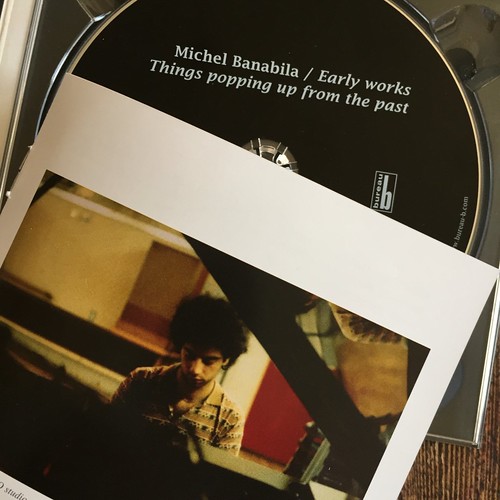
Released June 3, 2016.
Michel Banabila:
Roland S10 sampler, piano, found objects, harmonium.
Track 1: ovation guitar by Piet Legerstee.
Track 2: drone by Peter Riebeek.
Track 2: recorded by Peter Riebeek.
Track 1, 5, 6, 9: recorded by Jurgen Brouwer.
Track 3, 4, 7, 8, 10, 11: recorded by Michel Banabila.
Track 2: with kind permission by Trichord Records.
2016 ℗ + © all tracks published by Tapete Songs.
Liner notes booklet & inlay by Marc Weidenbaum.
Audio edits for this compilation: Radboud Mens.
Track 1 - 11: composed by Michel Banabila.
Photography by Marielle Uiterwijk Winkel.
Artwork design by Kerstin Holzwarth.
Compiled by Gunther Buskies.
Mastering by Jonas Förster.
BUREAU B
TAPETE RECORDS
Cat No BB227
CD No CD 123072
EAN CD 4015698004885
LP No LP 123071
EAN LP 4015698004892
Order at UNDERBELLY
Order at NORMAN RECORDS
Order at BOOMKAT


