Saturday, 19 November 2016

Periwinkle Here And Now: Macrocosms

(review by Perry Holt)

I know, it's not brand spankers, however, outing number four for Banabila & Machinefabriek - and it just keeps on getting better. Between them these two guys have such a plethora of musicality behind them that I feel the fourteenth release between them will still keep one intrigued and captivated. I got ruminating that this is their most exotica sounding release, that is, in a fourth world sense. Insect noise, digital clicks, bird song, synth keyed crystalline tones, ambient washes surge both subtlely and forcefully. Narration and radio transmission snatches, the microworld of human observation/language, appear and dissipate - subsumed by music and sound. There's a percussive thread throughout Macrocosms too, sampled and played through Rutger and Michels careful library of listening (check Turmoil, Echo Chamber), as too with all other sounds and music on this release. Also amongst these sources are sounds recorded at the Biała Woda nature reserve in Poland by Michel - here within a regional macrocosm are also the minutae of life - hidden worlds revealed. As with previous releases between them, the recording process was through file swapping. I wonder if through this, both Michel and Rutger's voices can sound more truly themselves; sounding more of a collaboration than a compromise. Or am I missing something there?! I got to first listen to this at cruising altitude above the ocean somewhere between Australia and Japan - between cultures. Apt. And detail, it unfolds continuously. I hear-look at paradise from afar, subsumed inside a dystopian threat - within a dream. This sense appears first in Kaleidoscope with its gamelan isolate and chinking buzz exotica, it closes with a dislocated kind of cooing, gorgeous. Then, as if looking down from a space station (or is it from a submerged city) with piped nostalgia choruses fed through a PA, so too does Upwards hint of this dread. There is still beauty within the waste however, koto strike, anthromusicological ephemera from a forest through the throats and tongue of men. Majesty broods, swells and surrenders in ambient free-float. Prey too sounds a forboding - slow drone hum builds and dissipates as gong miscellany fleck the sound-field. E-bow like sounds are sirens. Squirl and hum on close. So much detail! Cricket clicks & chirps, electric flutter and a lock groove sishi-odoshi suggest we're headed to the mad-house in Awake - before the forest beckons towards a calming glockenspiel melody and key tones. The flutter at closing is more avian - less electro-claustrophobic. Is that digitally altered tingsha in Turmoil? Tin water can strike foils, morse enters/leaves, a 1:22 clash heads into a sound fray and bird-song sonar returning to the songs beginning to end. All is not what it seems and excels on realisation. There's more to hear and immerse oneself within, whether canned or from the speaker, it rewards. Music from innumerable continents and imaginal realms - a post cultural melting pot of musical memory and remembering. Post apocalypse exotica - damning the romantics with the reality of mankinds decline.

http://periwinklehearandnow.blogspot.nl/2016/11/banabila-machinefabriek-macrocosms.html

Saturday, 12 November 2016

Rescoring La Antena - Esteban Sapir

The Chi Factory performed live during the screening of Estena Sapi's beautiful film La Antena, yesterday in Kino Rotterdam.

Commissioned by Cinesonic, The Chi Factory improvised with sampler, drums, bamboo flutes, clarinet, keyboards, voice and electronics.


Left - Hanyo Van Oosterom / Mid - Jacobus Derwort / Right - Michel Banabila. photo by Joke Schot.

CineSonic 64 - Chi Factory play La Antena from CineSonic on Vimeo.

Performed live by Hanyo van Oosterom, Jacobus Derwort & Michel Banabila, November 11, 2016.

My new keyboard - Yamaha P45 #Cinesonic #NachtVanDeFilm Esteban - La Antena #KinoRotterdam #soundcheck #TheChiFactory

A post shared by Michel Banabila (@michel_banabila) on

#JacobusDerwort #KinoRotterdam #HanyoVanOosterom #LaAntena #Cinesonic #soundcheck #TheChiFactory

A post shared by Michel Banabila (@michel_banabila) on

#LaNotte #KinoRotterdam #LaAntena #Cinesonic #TheChiFactory #soundcheck #rescoring #NachtVanDeFilm #Esteban

A post shared by Michel Banabila (@michel_banabila) on

#KinoRotterdam #TheChiFactory #soundcheck #MichelBanabila #LaAntena #Cinesonic #LaNotte #rescoring #NachtVanDeFilm

A post shared by Michel Banabila (@michel_banabila) on

Monday, 7 November 2016

Final revised version Big Data Poetry at Trouw (2013)

A final and revised version of Big Data Poetry - Geert Mul & Michel Banabila live at Trouw Amsterdam (2013) was just uploaded. A 23 minutes edit from a 45 minute live show

BIG DATA POETRY Stedelijk Museum Amsterdam @ trouw Geert Mul & Michel Banabila from Geert Mul on Vimeo.


One of the first versions of this audio visual live set is currently shown at the Stedelijk Museum Schiedam, as a high resolution 3 panel video installation with wireless headphones


Thursday, 29 September 2016

Out now: Macrocosms by Banabila & Machinefabriek


'Macrocosms' is the fourth collaboration album by Banabila & Machinefabriek. Again, Michel Banabila and Rutger Zuydervelt spent a few concentrated weeks swapping sound files and sculpting ideas to fully form tracks. This intuitive way of working and open-minded approach resulted in an album that harks back to the rhythmic playfulness of 'Travelog', while also maintaining the abstract tendencies of 'Error Log'. The overall theme deals with the macro and micro - how incredibly tiny and insiginificant we become when zooming out, and how wondrous small worlds can be found within ours when zooming in. Artist Sarah Payton describes it beautifully in her spoken word section of the title track.


Field recordings made by Banabila at the nature reserve Biała Woda in Poland are an important addition to the music, reinforcing the sense of place, and invoking intricate, detailed worlds of their own. Combining elements of ambient, musique concrète, noise, and even the 'fourth world', this Rotterdam duo created a unique sonic world expanding their oeuvre with another fine album. 'Macrocosms' is released by Tapu Records, in digital formats, and as a limited edition CD in a beautiful six panel digipack.


THE WIRE: "On the title track artist Sarah Paynton intones “Inside the single world we think we see are a hundred thousand separate worlds”. Simple, bold keyboard arpeggios run through the track and her voice is finally subsumed into a cloud of tiny sound particles that spiral off into fractal like shapes, making it an appropriate analogy to the different levels of detail in the duo’s music". (Mike Barnes)


UTILITY FOG: Dutch artists Michel Banabila & Rutger Zuydervelt aka Machinefabriek have been collaborating together since 2012, and their fourth album Macrocosm is out really soon! We got a sneak preview of a few tracks (the first one, and last two from this little feature), and I recommend grabbing the older releases and following either on Bandcamp so you can grab the new one when it appears. We hopped back to their first self-titled release, and to the amazing 2013 release Travelog in the middle. Banabila has been interested for decades in sounds (musical and otherwise) from the far reaches of the world, and has a long career making hybrid music from studio techniques, tape sampling & then digital methods along with acoustic instruments. Machinefabriek is best known for long drone works, but also works in shorter forms and is a master of digital sound design. It's great to have something new from their collaboration, which as always is more than the sum of its parts. (Peter Hollo)


Banabila & Machinefabriek: Kaleidoscope from Michel Banabila on Vimeo.

From: Macrocosms: https://banabila.bandcamp.com/album/macrocosms-cd

'Macrocosms' is the fourth collaboration album by Banabila & Machinefabriek. Again, Michel Banabila and Rutger Zuydervelt spent a few concentrated weeks swapping sound files and sculpting ideas to fully form tracks. This intuitive way of working and open-minded approach resulted in an album that harks back to the rhythmic playfulness of 'Travelog', while also maintaining the abstract tendencies of 'Error Log'.

The overall theme deals with the macro and micro - how incredibly tiny and insiginificant we become when zooming out, and how wondrous small worlds can be found within ours when zooming in. Artist Sarah Payton describes it beautifully in her spoken word section of the title track.

Field recordings made by Banabila at the nature reserve Biała Woda in Poland are an important addition to the music, reinforcing the sense of place, and invoking intricate, detailed worlds of their own. Combining elements of ambient, musique concrète, noise, and even the 'fourth world', this Rotterdam duo created a unique sonic world expanding their oeuvre with another fine album.

'Macrocosms' is released by Tapu Records, in digital formats, and as a limited edition CD in a beautiful six panel digipack.


Released September 28, 2016.
Music by Michel Banabila & Rutger Zuydervelt, Rotterdam, The Netherlands.
August / September 2016.
Mastered by Marlon Wolterink at White Noise Studio.
Double bass on Upwards sampled from Ilya Ziblat Shay.
Words on Macrocosms by Sarah Payton.
Photography by Michel, graphic design by Rutger.
Tapu Records © + ℗ 2016 / 018TR.
http://machinefabriek.nu
http://www.banabila.com


NORMAN RECORDS:
Regular collaborators Michel Banabila and Rutger Zuydervelt are back at it as Banabila & Machinefabriek with ‘Macrocosms’, the pairs fourth collaboration, no less. Beautifully presented in a matte digipak with photography by Michel and graphic design by Rutger. It’s worth noting that the CD edition varies from the digital release, in that the individual tracks have been melted into a continuous mix for a journey interrupted by brief pauses of silence. Across the disc, the lines between the real/organic and synthetic are blurred, utilising a seemingly endless vibrant palette of recognisable elements i.e “real” instruments and processed, electronic sounds and field recordings. The overall experience is something like glimpsing into worlds within worlds, within the world - Microcosms and Macrocosms. Something that’s always held an endless fascination for me. Take a dog for example, within that creature is a whole universe of smaller ecosystems, and other minute livings things like bacteria. Is our own planet just a single cell in a larger organism in an infinite universe? My head explodes just pondering these things. It seems the artists have similar thoughts and through sound conjure visions of these large and small scale worlds. It makes for pleasurable and thought provoking listening, at times recalling Jon Hassell and Brian Eno’s ‘Fourth World’ ambient. There’s an immense of amount of intricately detailed sound throughout the disc - like zooming into insect realms, then further into the very fabric of matter; cells, molecules and atoms. While larger sounds evoke images of weather systems and the cosmos. A wonderfully vibrant, organic sonic world that exists as a fusion of reality and imagination. (Anthony)

AMBIENTBLOG:
Their fourth collaborative album shows Michel Banabila and Machinefabriek in a playful mood, somewhat less abstract than on their previous album Error Log.
Macrocosms radiates the joy of swapping sound files and surprising each other in turn with an unexpected twist of the material: field recordings from the Biala Woda nature reserve in Poland, musique concrête, noise, ambient, ‘fourth world’ samples, ‘Holger Czukay style’ sped up guitars, and whatnot…

“The overall theme deals with the macro and micro – how incredibly tiny and insiginificant we become when zooming out, and how wondrous small worlds can be found within ours when zooming in.” Michel and Rutger are a perfect pair: two giants of Dutch experimental music, combining the best of many worlds. Abstract experimentalism, cinematic romanticism, impressionistic environmentalism… it’s all in the details that merge into a recognisable trademark style and manages to surprise with every new release. (Peter van Cooten)

A CLOSER LISTEN:
To date we have heard four full-length collaborations between Michel Banabila and Machinefabriek, each one different in tone. This one, while intricate and multi-faceted, is their most accessible to date. It all starts with a concept: the micro and the macro. Listening to the album is the aural version of zooming in and out with a hi-tech camera. Pieces of sound appear, migrate to different speakers, and dissipate. Zoom in and one can hear them better; zoom out and one can appreciate the overall picture. The cover art implies a scientist’s eye, so it’s no surprise that the music includes field recordings, made by Banabila in Poland’s Biała Woda (a reminder to check out Izabela Dłużyk’s Soundscapes of Summer, also recorded in Polish woods). The brightness of the album’s visual tones reflect that of the music, which at times can be downright danceable (“Stokjes”) ~ and when’s the last time one danced to field recordings? It doesn’t happen often. This joyful combination is what makes the album so accessible. One can imagine the artists opening each other’s sound files, getting excited about their next ideas, and committing them to tape. Crickets, choirs and children each find their places in “Upwards”, serving as both rhythm and adornment. The world itself is rhythmic, often intentionally but sometimes not; Banabila and Machinefabriek find hidden swayings and surround them with aural sculptures. Even when the track turns ambient, the listener recalls the tempo that launched the piece. But the title track is where everything comes into play. On this piece, Sarah Payton surprises with a spoken word segment that seems at first like a documentary excerpt, perfect for the nature (pun intended) of the release. Arriving at the album’s midpoint, the voice is unexpected, yet comforting. Inside the single world we think we see, a hundred thousand separate worlds go about their daily business, connected only by the thinnest of threads, a contingency of each only vaguely perceived by the others. Following the narrative, one zooms out even further, above the earth, recalling the photographic work of Yann Arthus-Bertrand. Piano, strings, static and samples provide an elegant backdrop against which Payton herself first approaches, then recedes, a metaphor for her own words. Some collaborations seem like work, but this one seems like play. It’s clear that the artists enjoy what they are doing and are inspired by this partnership. While we often write that we’d love to hear more of the same sounds, the duo has proven that they can change sounds and continue to entice. We already trust that their fifth album will intrigue in equal measure, no matter what its style. (Richard Allen)

Wednesday, 7 September 2016

Gerco de Ruijter

I was contacted by photographer Gerco de Ruijter a few years ago. When he showed me his work I was immediately impressed. He often uses a kite with a camera attached to make photos (kite photography). All beautiful art. This is a nice documentary about how he works:

Gerco De Ruijter from Fotofestival Knokke-Heist on Vimeo.

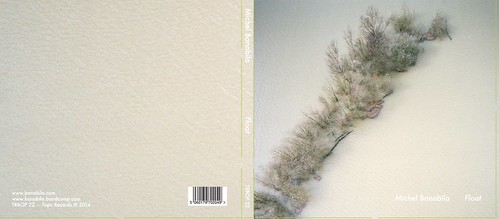
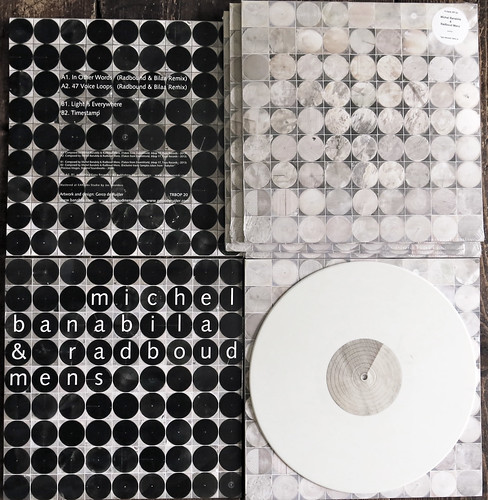
We became good friends. To my surprise it turned out he has known my music for quite a while.. and he proposed to make an album cover. That was the start of a long collaboration that is still going on. These are some of the covers he made for my albums:

Untitled
Float


Untitled
12 inch vinyl EP

Untitled
Banabila & Mens

Untitled
Untitled
Untitled
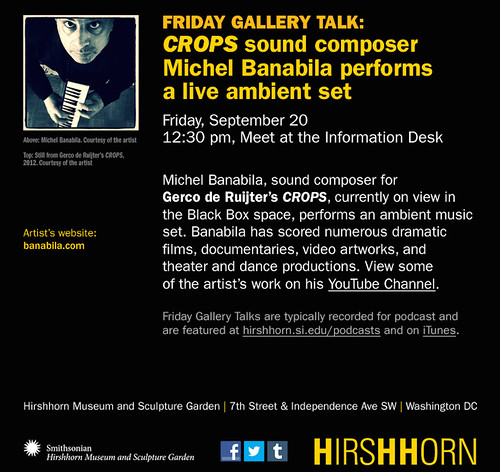
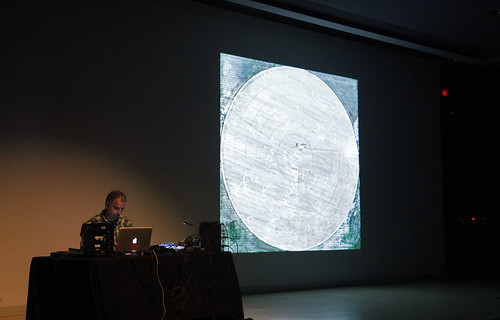
Four years ago he asked me to do the sound design for his short film 'Crops'. The response was really amazing ... the film was shown at many film festivals all over the world and we had an installation for 3 months in the Hirshhorn Museum in Washington where I also did a solo performance (electronics / ambient) and a small Q&A:

Crops (Gerco de Ruijter) from Michel Banabila on Vimeo.

CROPS is a stopmotion film on centre pivot irrigation in the USA. Long water-sprinkler arms rotate around a central pivot, irrigating circular fields of verdant crops in desert or semiarid environments. Often a well, located at the centre of the circle, pumps water up from vast aquifers in the rock formations below, or Rio Grande water is canalized and redirected into the deserts feeding the well. Once the Rio Grande reaches Mexico, it's riverbed has dried. This trailer was made using 1000 circles cropped in Google Earth. It is the starting point for a larger project to be released this year. Score by Michel Banabila. 2012 © Gerco de Ruijter. Untitled
Michel Banabila, Friday Gallery Talk - Hirshhorn auditorium, 2013.
Untitled
Earlier this year we did a new video collabs, Grid Corrections:

Grid Corrections (a one minute) from Gerco de Ruijter on Vimeo.

The video was featured on the great Bldgblog

Our most recent collaboration was on Ringdijk, a beautiful video installation for Panorama Mesdag
Sound for Ringdijk:


Gerco was also doing live projections during my concert with Oene van Geel in The Hague:

Banabila & Van Geel live at Rewire 2016 (snippets) from Michel Banabila on Vimeo.

And we performed live together during the Space Expo 2016 commissioned by Brand Urban Agency

Space Expo 2016 from Michel Banabila on Vimeo.

european-space-solutions.eu/space-expo
Samples taken from:

GOOGLE EARTH
google.com/earth
NASA
soundcloud.com/nasa


Above: cover for Sound Years (2017)

below: Ringdijk / Dike Ring, sound for a continuous loop installation:

RINGDIJK / DIKE-RING (2016) from Gerco de Ruijter on Vimeo.


AMBIENTBLOG - Banabila Exclusive: Dissolve (Free Download)

Tuesday, 30 August 2016

Atonal 2016

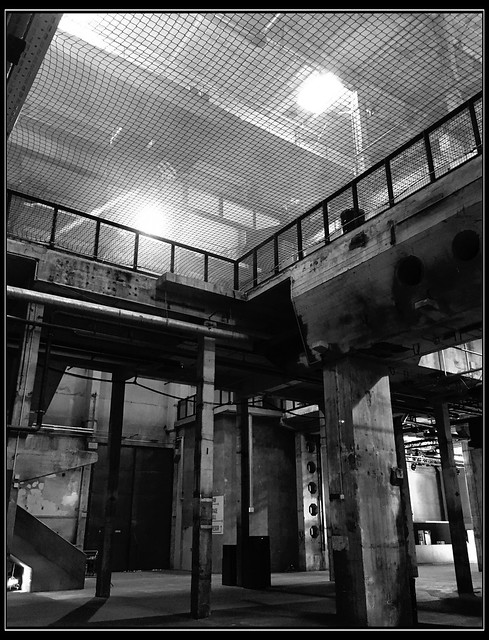
After the premiere at Cafe Oto where we presented our vinyl reissue from The Original Recordings from 1986 at Astral Industries in February, this time The Chi Factory played at the wonderful Atonal Festival in Berlin, to present the Bamboo Recordings by Koos & Hanyo. We had a lot of fun and got nice response. The Kraftwerk building is really impressive.
Untitled
We don't have the instruments from the old days anymore, like self made stuff, log drums, found objects, an old Teac recorder, and more, but we performed in Berlin with 3 members of the original Chi set up; Hanyo on drums, bass, Rhodes, and vocals, Koos on his bamboo flutes and on clarinet, and me with a laptop. I was a member of The Chi Factory from January 2016 until December 2016.


Chi Factory photos by Camille Blake and Helge Mundt.


The concert was an experimental mixture of jazz, contemporary, traditional music and ambient, using acoustic instruments , field recordings, many voice samples and electronics. Thank you Atonal!


Michel Banabila / Hanyo van Oosterom / Jacobus Derwort

Tuesday, 16 August 2016

Maryana Golovchenko

This morning I had a small recording session at my home with Maryana Golovchenko.
She sang a beautiful traditional entitled "Oj, Na Gori Suhyj Dub" (A dry oak on the mountain).
I added some synth and just finished the mix. It sounds dreamy .. a bit like a little meditation.
You can listen here


It's funny when I told her I just returned from Biała Woda, we realized I was not really that far from where this tune actually comes from, which is a place in the area of the Eastern Carpathian Mountains..

Note: this song was extended with a beautiful cello melody by Maarten Vos in November during the preparations for HOME, a dance performance by Conny Janssen Danst. "Oj, Na Gori Suhyj Dub" is now available on CD at the performances of HOME.


Maryana and I recorded together before, our first recording was for Jump Cuts, a track called Field Trip:


Maryana at Womex

Maryana Golovchenko, Mehmet Polat , Oene van Geel:


Music for HOME

Saturday, 13 August 2016

OOR

Vandaag een fijne recensie in muziekkrant OOR voor mijn Bureau B's Early Works album,
dank Oscar Smit !


"... compilatie vol slow music + tijdloos ambient-meesterwerk.."


Sunday, 7 August 2016

Biała Woda

Starting to explore my field recordings from the Biała Woda Rezerwat.
Will check the original LS-10 recordings and of course will listen to everything tuned 2 octaves lower too ;-)


Check this out on Chirbit

Untitled

Although I have a Roland R26 which is better I suppose, I felt more comfortable using the very small Olympus LS-10

Grid Corrections (a one minute) by Gerco de Ruijter

I made a sound piece for Grid Corrections, a stop motion video on vimeo (now 26.4 K plays) by the wonderful photographer Gerco de Ruijter

Grid Corrections (a one minute) from Gerco de Ruijter on Vimeo.


This film was made mining the Thomas Jefferson's Grid in Google Earth.
By superimposing a rectangular grid on the earth surface, a grid built from exact square miles, the spherical deviations have to be fixed. After all, the grid has only two dimensions.
The north-south bounderies in the grid are on the lines of longitude, which converge to the north. The roads that follow these bounderies must dogleg every twenty-four miles to counter the diminishing distances: Grid Corrections

Read more on Grid Corrections at the wonderful BLDGBLOG

Distribution: LIMA

Made possible with the generous support of the Mondrian Fund, Amsterdam.

Saturday, 6 August 2016

Peek-A-Boo review for Early Works reissue

A new review in Belgium magazine Peek-A-Boo for Things Popping Up From The Past this week!

Earth Visitor

Ambient.

A lot of rain in June. Watching NASA videos about the Juno mission. Then this is what happens ...

We Are The Aliens from Michel Banabila on Vimeo.


AMBIENTBLOG:
June was a very rainy month, which was why Michel Banabila spent a lot of time watching NASA videos about the Juno mission. Or, maybe I’d better rephrase that: after watching the NASA videos he spent a lot of time creating this album which was inspired by the Juno mission.
In retrospect, we can be happy this was no ordinary sunny month, because inspired him to create this great album! Starting out with a piano theme that demonstrates why his music works very well in theatre and documentary soundtrack settings, the tracks focus on outer space – becoming more abstract while never losing their melodic, human, touch.
 Alien electronic soundscapes, sometimes ‘earthened’ with violin samples (performed by Salar Asid), piano, cat meows, and many distorted voice fragments (the kind that unmistakably identifies Banabila‘s work). With titles like What Creature Is That and We Are The Aliens, this album’s viewpoint is nót only that of earth’s astronaut, but also of the imaginary Jupiter inhabitant watching the earth invaders approach. After working ceaselessly and tirelessly for more than thirty years, recent re-issues of his early work finally gained the international acclaim it deserves (the Bureau B compilation Early Works / Things Popping Up from the Past and Astral Industries reissue of Chi Original Recordings). But it’s important not to get stuck in the past: Banabila is alive and kicking and still creating an impressive stream of new music! With his recent albums, Michel Banabila has explored many – often experimental – territories. Earth Visitor demonstrates he’s also still a master of cinematic ambient! (Peter van Cooten)


Special thanks to:

Radboud Mens for Izotope edits and check.
Salar Asid for contributed sample on "Earth Visitor" (violin).
Oscar Roelof Peterse for recording the piano on "Earth Visitor."
Tapu, my cat, for contributed sample on "Earth Visitor" (meow).
Rutger Zuydervelt, Gunther Buskies, Marc Weidenbaum, Joeri Mol and Hanyo van Oosterom for essential feedback.

Released July 10, 2016.

Composed & performed by Michel Banabila. Instruments:
piano, synthesizer, sampler, field recordings, voice, guitar.

I took the cover photo from a train from Tokyo to Narita , 2016.

Untitled

017TR / Tapu Records ℗ 2016

Passing By from Michel Banabila on Vimeo.

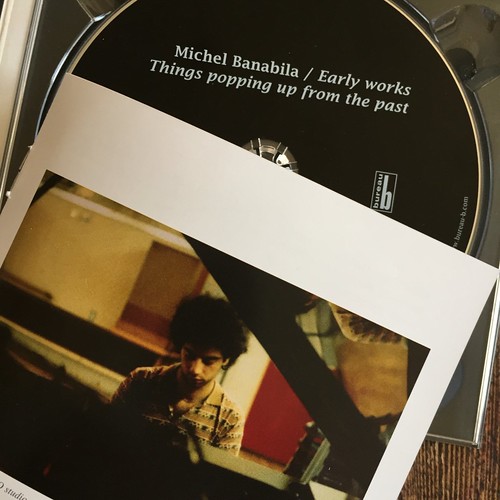
Early Works: Things Popping Up From The Past

The wonderful German Bureau B label released in June 2016 a selection compiled by label boss Gunther Buskies from my early recordings on CD and vinyl


Michel Banabila, born 1961, is a sound artist, composer, and producer.
Banabila releases music since 1983 and has produced musical scores for numerous films, documentaries, theatre plays and choreographies.
This album collects 11 songs from his early years, released on tape, vinyl EPs or limited CD editions: beautiful minimal loop-based electronica, neo-classical pieces and ambient drone music.
A true discovery! (Bureau B)


Early Works: Things Popping Up From The Past (2016 reissue) liner notes:

Numerous threads run through the music of Michel Banabila, whose contemporary work ranges from adventurous electronic cross-breeding of chamber instrumentation, to industrial rhythmic sampling, to outward-bound modular synthesis, to deeply elegiac drones.

What is remarkable about this collection of early pieces is just how many of Banabila’s ongoing fascinations had already taken root, when he was barely half his current age. The child apparently is not merely the father to the man; he is also his music tutor. In particular, there are extended sequences of neoclassical loveliness and dense patches of Fourth World exploration that, matters of specific equipment aside, could have been recorded yesterday. Except that they weren’t.

The classical activity heard here constitutes a romantic attachment to the Old World, filtered through a contemporary sense of proportion. Banabila’s piano, its atmospheric gestures bringing to mind the proto-minimalism of Erik Satie, echoes with a disarming simplicity. The sweetness of the tune masks his determined compositional focus on loop-like repetitions, on the ever so slight variations between pulses, on training the listener’s ear to hear inside the notes, between the notes, to be receptive to matters that are more tactile than tonal. The melody could easily be an additional hundred years old — except for fact that the refined patterning is something that likely only could have been pursued in light of the music of Michael Nyman and Philip Glass. Similarly, a solo harmonium performance circles around a song that could be a maudlin street-corner serenade in a benighted district of a nameless Eastern European city — and yet it has a self-consciousness of the instrument’s breath-like quality that marks it, however subtly, as modern music.

And, of course, this isn’t modern music. This is music several decades after the fact. It is no longer of our time. The equipment on which it was made, notably an early sampler, was limited in various ways, key among them the relatively circumspect set of capabilities, especially in terms of memory storage, and the lack of received performance techniques. The equipment was simple and it was new, and neither factor limited Banabila’s ambition; to the contrary, the tools concentrated his imagination.

If the classical pieces represent the Old World as framed by the new, then the more recognizably “electronic” work here is likewise most at home in a fictional place, an idealized zone. That zone is a quiet neighborhood in the Fourth World, to borrow Jon Hassell’s terminology, one in which digital tools render something that is, for all its technological dependency, ultimately a form of folk music — an otherworldly folk music for another time. At that time and in that place, a percussive guitar figure lends momentum to ethereal synthesized choral vocals. Fidgety percussion plays amid a fierce but restrained guitar line (there are echoes of Laurie Anderson and Adrian Belew). An ambiguous and elongated drone, thick with subliminal activity, beautiful in its toxic anxiety, suggests dire activity on the horizon.

And yet the horizon wasn’t dire. Quite the contrary, what was ahead for Banabila was a long string of releases, a healthy and well-documented career in which so many of these individual threads have been provided time and space to have entire records dedicated to their pursuit. This album of archival works is a document, and what it documents is the continuity inherent in Banabila’s music. It is a map in musical form, and the path it traces is one that crisscrosses back and forth between the Old World and the Next.

Marc Weidenbaum / Disquiet
San Francisco, California
February 2016.


Reviews:

THE RECOUP:
Michel Banabila is a prolific Dutch experimental composer, specializing in minimalist electronica. He’s quite prolific, too; on Discogs, he has fifty-two albums to his credit, and that’s just to his name, not including his side projects. His work has a unifying sound: the beauty of ambient music, as performed by modern technology. Bureau B’s new compilation Early Works does an admirable job of introducing Banabila to the listener unfamiliar with his work. For the most part, the compilation goes straight for the gentle, delicate work. It’s hard not to drift off into a netherworld of pleasantness when listening to “October” and “The Call.” Harold Budd is recalled on “Piano 1” and “Piano 2,” as well as on the gorgeous “Harmonium Improv 1” and “Harmonium Improv 2,” which tempers the delicateness of piano with a hushed, cooling drone that never imposes any heaviness on the listener. Not that he can’t do drone well; “The Lost Drone Tapes” show that he’s a master of that style, too; the sounds and atmosphere is heavy, but it’s never short of beauty. Banabila has released a lot of music over the course of three decades; one can find his work scattered throughout the internet, via Spotify, Youtube, and other sources. But Early Works offers an excellent look at the man’s early years, where it’s obvious that Banabila realized quite early that he is a gifted, talented composer. This music serves as a perfect escape from the heat of an oppressive Summer sun. (Joseph Kyle)

OEDIPE PURPLE:
Alors que son album Marilli figure en bonne place dans notre wishlist, le label Bureau B a eu la bonne idée de ressortir du placard les splendides harmonies de Michel Banabila. Une invitation à la rêverie qu’on ne peut refuser, à l’instar du premier morceau October… On repeat.


NOWAMUZYKA:
Niemiecka wytwórnia Bureau B opublikowała płytę z bardzo rzadkimi utworami Michela Banabily, które powstały na początku jego kariery. Nie tak dawno recenzowałem podwójny album „Tapu sampler” holenderskiego muzyka, kompozytora i producenta, będący zbiorem jego nagrań z lat 2007-2015. Można potraktować ten materiał jako szybki sprawdzian z tego, co w ostatnich latach prezentował Banabila. W przypadku longplaya „Early Works / Things popping up from the past” cofamy się w czasie jeszcze dalej gdzieś w okolice lat 80., ponieważ z tego okresu pochodzą kompozycje. Przypomnę, że artysta aktywnie działa od 1983 roku. Na „Early Works…” znajdziemy jedenaście różnych utworów nie tylko pod względem brzmienia czy użytych instrumentów, ale przede wszystkim pokazujących szeroki wachlarz możliwości tego utalentowanego kompozytora. W takich fragmentach jak „Harmonium improv #1/improv #2” i „Piano No. #1/#2” można doszukać się – jak trafnie zauważył Marc Weidenbaum w swoim tekście – inspiracji twórczością Michaela Nymana oraz Philipa Glassa. Ale na tym krążku są też takie nagrania, które mogłyby być zarejestrowane dosłownie wczoraj, choćby dwa ambientowe „Des Traces Retrouvées I, No. #4”, „The Lost Drones Tape No. #2” i bardziej eksperymentalne „The Workers”. W lekko etnicznym „A Sharp Silver Line” z kolei mamy solówkę gitarową Banabily bliższą stylowi Adriana Belewa z King Crimson. Niesamowite jest to – jak już wspomniałem – że większość utworów z tego zestawu nie kojarzy się z kiczem lat 80., nawet nie ma przepychu jeśli chodzi o syntezatory, a jak już są to raczej w aranżacjach z pogranicza minimalizmu i muzyki klasycznej. Mimo dużej rozpiętości stylistycznej, „Early Works/Things popping up from the past” słucha się jako całości. (Łukasz Komła)


NORMAN RECORDS staff review:
This a collection of early works by Banabila, he has previously done all sorts in his career including theatre. But don’t let that put you off as this collection has some moments that you’ll want to spend time visiting if you are a fan of Michael Nyman or Philip Glass. The opening ‘October’ could in fact come from any number of Woo LPs. Elsewhere we get off kilter piano compositions (‘Piano no 2’), Eno/Fripp-like instrumental scapes with wobbly guitar solos (‘A Sharper Silver Line’) and all manner of variations of oddball drones. Some of it’s disconcertingly angular and some is truly mesmeric, ‘The Call’ in particular runs Eno’s ‘Another Green World’ fairly close in faded 70s nostalgia synth. A delightful collection, your ears will thank you for it. 8/10 (Clinton)

UNDERBELLY:
Need I still explain Michel Banabila? After his recent period of increased productivity, the “Retro-Market” has found him, too. After all, he started releasing records in 1983, so the time is here. This album collects 11 songs from his early years, released on tape, vinyl EPs or limited CD editions. There’s a great variety – besides the kind of electronic loop-based world-ambient that made him so well-known – like two improvisation pieces on harmonium, found back in his enormous collection of tape recordings, never published before, some minimalist Satie-esque piano pieces, and more abstract, textured drones. The overall feel is that of intimacy, withdrawal and sweet melancholy. (Mariette Groot)


VITAL WEEKLY 1037:
'To hear his first album 'Marilli', go to Michel's bandcamp page and listen to an extensive remix version of it, and you can hear the various traces of the original, but reworked, by Banabila and his many friends; it's a highly recommended remix project'. 'For a real glimpse of old days, Bureau B just released this eleven song release, with four previously unreleased pieces, and pieces from 'Des Traces Retrouvees I' and 'Des Traces Retrouvees III' and 'The Lost Drones Tapes'. These pieces no longer work using ethnic voices (as was apparent on 'Marilli'), but purely dwell on Banabila's own playing of the Roland S10 sampler, piano, found objects and harmonium. Banabila's music these days may take many forms, from modular synth to electro-acoustics to ambient, in these old days it was all about moods and textures'. 'The music is dreamy and meditative but never borders on the tired clichés of new age; it sounds naive but after some thirty years it is also surprisingly fresh. It's minimal music and it always remains very playful, never very strict'. 'These eleven pieces are a highly varied bunch but it makes great sense putting these together. Not just because it shows the many sides of Michel Banabila (even back then!), but also because it makes such a great listen. Always atmospheric but with delicate touches on offer, this is a great CD. (FdW)

GONZO CIRCUS 134:
Sinds 1983 overstelpt de Nederlander de mensheid met releases, die meestal behoorlijk interessant zijn. Voor deze collectie ‘vroeg werk’ dook Bureau B de archieven in en komt naar boven met nummers uit ‘Des Traces Retrouvees I’ (1984), ‘Des Traces Retrouvees III’ (1987) en ‘The Lost Drones Tape (1988). Cassettes en een mini-album die al jaren onvindbaar zijn en hier worden aangevuld met vier onuitgegeven nummers die verder bouwen op wat de ooit verschenen stukken al lieten horen. En dat is een Banabila die ondanks de beperkingen van het materiaal in die tijd, inventief aan de slag ging. Harmonium improvisaties, stijlvolle ambient, en piano muziek die erg klassiek aandoet, wisselen elkaar af. We denken meteen aan Erik Satie, vroege Philip Glass, en Michael Nyman, mede door het filmische karakter van de meeste nummers. Banabila zit er dan ook niet om verlegen muziek te componeren die in allerlei disciplines kan worden gebruikt. ‘Early Works / Things Popping Up From The Past’ is een mooie aanvulling op het fysiek beschikbare werk van veelzijdig artiest Banabila (PB)

Untitled POLYPHONIA:
Holenderski muzyk Michel Banabila nie daje nam odpocząć! Płyty z jego najnowszymi nagraniami ukazują się bardzo często. Okazuje się jednak, że również w przeszłości Michel miał wiele do powiedzenia na polu muzyki elektronicznej i nie tylko! Krążek „Early Works / Things Popping Up From The Past„, ukazał się na płycie CD, ale także na płycie winylowej nakładem wytwórni Bureau B, która to wytwórnia specjalizuje się właśnie w wydawaniu wczesnych prac muzyków, którzy utrwalili swoje miejsce na niezależnej scenie muzycznej. Tak, aby mieć to już za sobą, napiszę od razu o tym, co wg mnie jest mankamentem tego wydawnictwa – jedenaście utworów nie stanowi bardzo spójnego przekazu muzycznego, a to dlatego, że każdy z nich jest trochę „z innej bajki” i trochę z innego okresu twórczości – część z lat 80tych, a inne są aż o dekadę młodsze! Jednocześnie ten mankament może stanowić też o sile przekazu tego wydawnictwa! Jeśli nie poszukujemy albumu koncepcyjnego, opartego na podobnych brzmieniach, czy pomysłach realizacyjnych, to „Early Works…” stanowi świetną okazję do tego, by zapoznać się z zupełnie różnymi podgatunkami muzycznymi – od eksperymentów brzmieniowych, przez ambient czy drone, aż po krótkie szkice zagrane na pianinie. Mimo tego, że utwory powstały w latach 80tych i 90tych, nie słychać w nich żadnych inspiracji modnymi w tamtych czasach gatunkami muzycznymi. Banabila wypracował bardzo unikatowy styl, który przenosi na coraz to nowy poziom w kolejnych swoich współczesnych wydawnictwach, a przy okazji „Early Works…” słuchacz dowiaduje się, że już w początkach swojej kariery (którą datuje się na rok 1983), artysta poszukiwał nietuzinkowych środków wyrazu artystycznego. Ciekawe kompozycje to prace oparte na pętlach: „October (Des Traces Retrouvées III)”, „A Sharp Silver Line (Des Traces Retrouvées III)” gdzie można dostrzec podobieństwo do nagrań King Crimson i stylu Andriana Belewa. Moimi osobistymi faworytami są utwory, w których Banabila korzysta z pianina: w „Harmonium improv #1/improv #2” i „Piano No. #1/#2” można dostrzec inspiracje pracami Philipa Glassa – jednocześnie uważny słuchacz odnajdzie w nich tak popularny dzisiaj styl rozwijany przez Nilsa Frahma. Świetne są też momenty dronowe – „The Lost Drones Tape No. #3 (The Lost Drones Tape)” i ambientowe „The Lost Drones Tape No. #2 (The Lost Drones Tape)”. Jak zwykle Michel Banabila nie pozostawia słuchacza obojętnym na swoje dokonania na polu muzycznym. Wszystko wskazuje na to, że po zapoznaniu się z tak ciekawymi początkami kariery Holendra, możemy spokojnie otworzyć umysł, by zagłębić się w jego współczesne dokonania. (Grzegorz Bojanek)


Untitled


Released June 3, 2016.

Michel Banabila:
Roland S10 sampler, piano, found objects, harmonium.

Track 1: ovation guitar by Piet Legerstee.
Track 2: drone by Peter Riebeek.
Track 2: recorded by Peter Riebeek.
Track 1, 5, 6, 9: recorded by Jurgen Brouwer.
Track 3, 4, 7, 8, 10, 11: recorded by Michel Banabila.
Track 2: with kind permission by Trichord Records.
2016 ℗ + © all tracks published by Tapete Songs.
Liner notes booklet & inlay by Marc Weidenbaum.
Audio edits for this compilation: Radboud Mens.
Track 1 - 11: composed by Michel Banabila.
Photography by Marielle Uiterwijk Winkel.
Artwork design by Kerstin Holzwarth.
Compiled by Gunther Buskies.
Mastering by Jonas Förster.

BUREAU B
TAPETE RECORDS

Cat No BB227
CD No CD 123072
EAN CD 4015698004885
LP No LP 123071
EAN LP 4015698004892


Order at UNDERBELLY

Order at NORMAN RECORDS

Order at BOOMKAT


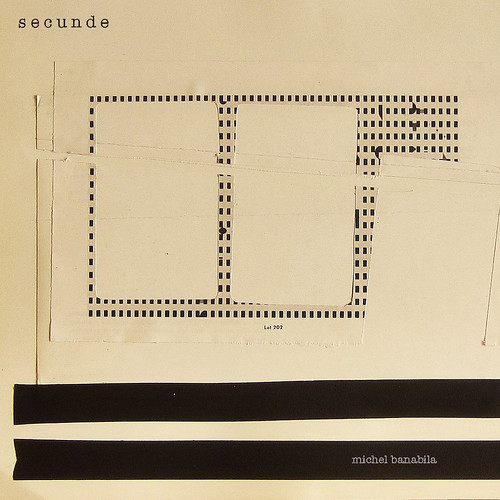
Secunde

On Tiny Elements I played a few simple melodies and chords with sine tones, with lots of spaces in between, using a sampler without samples loaded. I invited Oene van Geel to play the chords and melodies on the viola and Keimpe de Jong to play some lines on clarinets.

The other 3 tracks are basically made from this first track.
Everything on Drawing with Closed Eyes are sampled parts from track 1, pitched down with a sampler. Drawing with closed eyes is a game I enjoy playing with my daughter. It's exciting to see what we come up with, never knowing exactly what images will reveal themselves ;-) Doing track 2 with the sampler felt a bit the same, since I cannot read or write notes and had no clue what I was actually doing. Just trusted my ears to find the combinations of chords that would go nicely together. So one mix was a fifth lower and one mix was an octave lower. I placed these two lowered files below the original in Logic and subsequently composed the track by cutting from all three files. Sounds were added on the melodica and I asked Keimpe to play saxonett and Ilya Ziblat Shay to play sound effects on contrabass.

Deep Dream is track 2 treated with Michael Norris software. The whole track was transposed lower again, using a sampler. After that I took an improvisation by Oene van Geel, originally played (but not used) on track 1, tuned it down and mixed it together with this track.

For Audio to Midi I asked Radboud Mens to use Ableton Live to transform the audio from track 2 into midi notes, as I was curious about the info of the lowered chords from the sampler. But the mix was too complex and the result of the midi notes sounded a bit weird. However, these midi notes played by piano samples on higher speed, using an extremely short decay inspired me to make one last track with it. Finally I added some field recording and melodica sounds.


Released February 18, 2016.

Oene van Geel: viola, violin.
Ilya Ziblat Shay: contrabass.
Michel Banabila: sampler & melodica.
Keimpe de Jong: clarinet, bass clarinet, saxonett.

Artwork by Harold McNaron.


A special thanks to:
Joeri Mol for general feedback.
Yaşar Saka for edits in melodyne.
Radboud Mens for spectral edits in Izotope & a. live audio to midi.

Secunde: Tiny Elements / Drawing With Closed Eyes from Michel Banabila on Vimeo.


[1,2,4] arranged by Michel Banabila.
[3] arranged by Michel Banabila & Oene Van Geel.

SoundMagic Spectral used on track 3 is a freeware suite of 24 Audio Unit plug-ins by Michael Norris.

Composed & recorded by Michel Banabila.

Oene van Geel
Keimpe de Jong
Ilya Ziblat Shay

SECUNDE CJD REMIX:


2016 © Tapu Records / 015 TR.

Untitled

Feedback + Modular + Radiowaves


KINDAMUZIK:
Drie namen voor een beestje waarin drie gezichten te horen zijn; feedback - check!, modulaire synthesizer - check!, radiogolven - check! Heb je nog helemaal niks aan als je geen idee hebt wat het is, wat je ermee moet en hoe je er een beluisterbaar album of twee van moet maken. Enter: Michel Banabila; jarenlange ervaring in de achterzak, experiment hoog in het vaandel en dan vooral: nieuwsgierigheid naar waar de apparatuur hem voor verrassingen plaatst. Op deze twee albums jakkert Banabila dartel over knopjes; hij lijkt druk in de weer met podmeters en patchkabels. Een antenne plukt fragmenten statische ruis en stukjes uitzending uit de ether. Her en der knarst iets. Een pruttelende golftoon komt op; feedback dreigt nadrukkelijk platwalsend een mengpaneel zonder inputs over te nemen. Gaat daar nu de deurbel? Of is het toch een op hol geslagen brokje elektronica ergens in de keten? Banabila weet verdraaid goed wat hij kan doen, maar laat ook los. Hij weet speels vrijheid te behouden en daardoor ademen de platen een letterlijk experimenteel musique concrète-achtig aura. Verknipt en elektroakoestisch, maar ook vloeiend en verhalend; geïmproviseerd, maar ook met een hand aan de trapleuning van de rode draad. Naar beneden stuiken is er dan ook niet bij. Machinerie komt tot leven en blijkt ook gewoon een speelgoeddoos. De spullen moeten bijeen gebracht worden als op een assemblageband; tegelijk ben je wel eens wat kwijt, verkeerd neergelegd, file kwijt of corrupt, bandje terugspoelen. Drievlakselektronica kan een steriele bedoening worden waarin kille processen zich achter glimmende frontjes afspelen, met daartussen een bult spaghetti aan kabels. Ongetwijfeld zal het in Banabila's studio zo'n zooitje geweest zijn aan apparaten. Zijn absolute meerwaarde bestaat eruit dat hij de machines tot een warmbloedigheid wekt; modulaire processen en golven uit de lucht in interfererende botsingen brengt, luistert en die feedback weer kunstig inzet. En dan kom je ergens in de hoek van 8 bit-achtige gekte, Asmus Tietchens, Felix Kubin en ook de grootmeesters van de GRM, zoals Guy Reibel, uit. Nederconcreet; een nieuw genre ? (Sven Schlijper)

FEEDBACK + MODULAR + RADIOWAVES:


Untitled

Released October 14, 2015.

Michel Banabila: feedback, A-100 modular, WebSDR, fieldrecording.

Edited and recorded in Logic Pro.

Cat. nr. 011TR.
2015 © + ℗ Tapu Records.

FEEDBACK + MODULAR + RADIOWAVES II:


Released November 12, 2015.

Michel Banabila:
feedback, A-100 modular, monotron, webSDR, fieldrecording, tape.
Radboud Mens:
sinewaves, clicks and bass (3)
Edited and recorded in Logic Pro.

1,2,4,5,6 composed by Michel Banabila.
3 composed by Michel Banabila & Radboud Mens.

Cat. nr. 012TR.
2015 © + ℗ Tapu Records.

FEEDBACK + MODULAR + RADIOWAVES III:

AMBIENTBLOG
FMR3 is the third and final (?) release in Michel Banabila‘s series of experiments in combining the three sound sources from the title. It opens in quite a radical way with a loud synthetic gong that immediately draws full attention, followed by a minimal machinelike noise – an industrial meditation. Modular synths are very fashionable, but too often the musical results only interesting for the nerdy buttonfreaks using them – there’s too much of ‘what does thís button do??’. But not in Banabila‘s hands. By using clever combinations of different sources, and by careful manipulation, his compositions – even the most minimal ones – get a fascinating cinematic tension. In Banabila‘s diversely branched discography, the FMR series is connected to his electronic works (like The Department of Electrical Engineering releases) and thus quite a lot more experimental than his works for theatre, his jazz-related outings or his crossovers with world-music. Michel Banabila still manages to combine the best of a lot of musical worlds in his rapidly growing discography, and there’s no sign of slowing down! (Peter van Cooten)


released January 31, 2016.
Michel Banabila:
feedback, A-100 modular, webSDR, soft.synths, sampler, fieldrecordings.

Lukas Simonis:
guitar - feedback sounds [1,3,6].

Track 2 recorded live at Noodlebar, PinkPank Rotterdam, January 23th, 2016.

Cat. nr. 014TR.
Edited and recorded in Logic Pro.
Composed by Michel Banabila.
2016 © + ℗ Tapu Records.


GONZO CIRCUS:
Michel Banabila is een veelzijdig componist. Hij werkt bij voorkeur met synthesizers waar hij een duizelingwekkende veelheid aan klanken uit tevoorschijn peutert. Hij schrijft voor ensembles, verwerkt omgevingsopnamen in zijn muziek. Die muziek is te horen bij films en, vanzelfsprekend, in optredens - onder meer in het bloeiende en groeiende circuit van analoge elektronica. Dat laatste genre komt volop aan bod op ‘Feedback + Modular + Radiowaves II’, zoals de titel al aangeeft het tweede album in een serie waarvan onlangs ook een derde deel verschenen is. Banabila zet contrasterende geluiden tegenover en achter elkaar: onstuitbaar verende toontjes, een langgerekt dor raspen, bliepjes en bloepjes, een opgewekt borrelen, een langs het verschiet snellend fluitje. ‘Basic Patch’ is een onafgebroken stoet van klankwagentjes, het ene nog maller en merkwaardiger dan het volgende. Soms heb je het gevoel een immens losbarstend onweer te horen naderen, maar dat wordt al snel onschadelijk gemaakt met ritmes waar het hoofd onwillekeurig glimlachend op gaat meedeinen. Het afsluitende ‘Radio Sky’ ontvouwt zich langzaam met nasaal trillende bassen en rondspokende fluittonen, alsof hij je na al die opwinding en variatie toch wat rust wil gunnen. (Rene van Peer)

3 from Michel Banabila on Vimeo.